
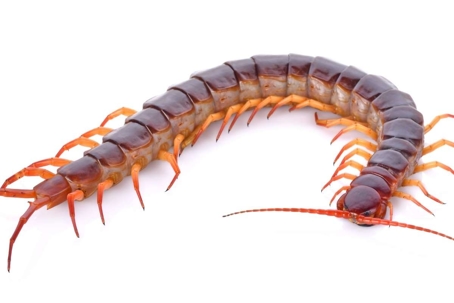
What Do Centipedes Eat?
Centipedes are carnivorous arthropods that primarily feed on other small animals. Centipedes are active hunters. They use their forcipules—specialized front appendages that inject venom—to paralyze prey before consumption. They prefer live prey but may scavenge if the opportunity arises. Their feeding strategy is largely opportunistic, targeting prey that is abundant and manageable in size relative to the centipede itself.
Do Centipedes Eat Crawling Insects?
Centipedes primarily eat crawling insects. In fact, crawling or ground-dwelling insects make up the bulk of their diet because centipedes are ambush predators that hunt along the ground, under debris, or in soil and leaf litter.
Centipedes locate prey using their antennae to sense vibrations and chemical cues. Once they encounter a suitable target, they use their forcipules—venom-injecting front appendages—to paralyze it before feeding. Smaller centipedes focus on insects that are roughly their own size or smaller, while larger species can tackle more substantial crawling prey, including worms or even small vertebrates.
Their efficiency as predators of crawling insects is one reason centipedes are considered beneficial in controlling pest populations.
Do Centipedes Eat Ants?
Yes, centipedes do eat ants, including carpenter ants. Centipedes are carnivorous arthropods that feed on a variety of small invertebrates, and ants are among their common prey. Centipedes are skilled hunters and use their keen sense of touch and chemoreception to locate potential prey. When they encounter ants, they often inject venom into them to immobilize and subdue them, and then they use their sharp, venomous fangs to feed on the ants. Ants are typically part of the centipede's diet, as centipedes are opportunistic predators and will consume a wide range of small invertebrates, depending on what is available in their habitat. However, the specific types of ants and the frequency of ant consumption can vary depending on the species of centipede and the local ecological conditions.
Do Centipedes Eat Bed Bugs?
Yes, centipedes are known to eat bed bugs. Centipedes are carnivorous arthropods that feed on a variety of small invertebrates, and bed bugs are one of the prey items that they may consume. Bed bugs are blood-feeding insects that often inhabit bedding and furniture, and when centipedes come across them, they are likely to prey on them. Centipedes use their venomous fangs to immobilize and subdue their prey, and bed bugs are within the range of potential prey for many centipede species.
Centipedes are opportunistic predators, and their diet can vary depending on their species and the prey available in their environment. While bed bugs are not a primary food source for centipedes, they are part of the diverse array of small invertebrates that centipedes may hunt and consume in their quest for food.
Do Centipedes Eat Beetles?
Yes, centipedes eat beetles. Beetles, being mostly ground-dwelling or slow-moving, are suitable prey for centipedes, though the species and size of the beetle influence whether it can be captured.
Centipedes hunt beetles by sensing vibrations and chemical cues with their antennae. Once they locate a beetle, they strike with their forcipules—venomous front appendages—to immobilize it. Smaller beetles are easier for most centipedes to handle, while larger centipedes can tackle bigger beetles or softer-bodied species. Some beetles with hard exoskeletons may be avoided or only partially consumed.
This predatory behavior makes centipedes effective natural controllers of beetle populations in soil, leaf litter, and indoor environments.
Do Centipedes Eat Cockroaches?
Yes, centipedes do eat cockroaches. Centipedes are carnivorous arthropods, and they are known for their voracious appetite for various small invertebrates. Roaches, being insects, are a suitable and common prey item for many centipede species. When a centipede encounters a roach, it will typically inject venom into the roach to immobilize and subdue it, and then use its sharp, venomous fangs to feed on the roach.
Centipedes are opportunistic predators, meaning they will consume a variety of small invertebrates depending on what is available in their habitat. While their primary diet may vary by species and local environmental conditions, roaches are certainly within the range of potential prey for centipedes.
Do Centipedes Eat Crickets?
Yes, centipedes eat crickets. Crickets are ideal prey for centipedes because they are ground-dwelling, relatively slow compared to flying insects, and abundant in many habitats.
Centipedes detect crickets through vibrations and chemical signals. Once they locate a cricket, they use their forcipules—specialized venom-injecting appendages at the front—to quickly paralyze it. After immobilization, the centipede consumes the cricket, often starting with softer body parts.
Both smaller centipedes and larger species prey on crickets, though the size of the cricket relative to the centipede determines whether it is an easy meal. In indoor or garden environments, crickets are among the most common and readily captured prey for centipedes.
Do Centipedes Eat Earwigs?
Yes, centipedes eat earwigs. Earwigs are small, ground-dwelling insects, which makes them an accessible and suitable prey for centipedes. Centipedes use their antennae to detect earwigs’ movements and then quickly strike with their venomous forcipules to immobilize them before feeding.
Smaller centipedes can easily handle common earwigs found indoors, while larger soil-dwelling species can take on bigger earwigs in gardens or forest litter. Earwigs are particularly vulnerable because they are slow movers when compared to flying insects, and they often hide in damp, dark areas—exactly where centipedes hunt.
Centipedes are considered beneficial predators for earwigs and other small, pest-like insects in homes and gardens.
Do Centipedes Eat Fleas?
Yes, centipedes are known to eat fleas. Fleas are small, blood-feeding parasites that infest mammals, including pets and humans. Centipedes are carnivorous arthropods and opportunistic predators that feed on a variety of small invertebrates. When centipedes encounter fleas, they are likely to prey on them.
Centipedes have venomous fangs that they use to immobilize and subdue their prey, and fleas are within the range of potential prey for many centipede species. While fleas are not typically a primary food source for centipedes, they are part of the diverse array of small invertebrates that centipedes may consume when they find them in their environment. Centipedes help control the populations of various small pests and parasites, such as fleas, in the ecosystems where they are present.
Do Centipedes Eat Silverfish?
Yes, centipedes eat silverfish. Silverfish are small, fast-moving, nocturnal insects that inhabit dark, damp areas such as basements, bathrooms, and kitchens—environments where centipedes are also commonly found.
Centipedes are highly effective predators of silverfish. They use their long legs to move quickly and their venomous forcipules to immobilize the silverfish before feeding. The hunting is usually done at night, when both predator and prey are most active.
Silverfish are considered ideal prey because they are relatively small, soft-bodied, and abundant in human dwellings, making them a significant food source for centipedes.
Do Centipedes Eat Springtails?
Yes, centipedes eat springtails. Springtails are tiny, soil-dwelling arthropods that live in leaf litter, under stones, and in other damp environments—exactly the habitats centipedes hunt in. Their small size and relatively slow, hopping movements make them easy prey for centipedes.
Centipedes use their antennae to detect the presence of springtails and then strike with their venomous forcipules to immobilize them. Both smaller centipedes and larger species readily feed on springtails, which are a common part of the diet for centipedes in soil and forest-floor ecosystems.
Because springtails reproduce quickly and are abundant, they serve as a reliable, consistent food source for many centipede species.
Do Centipedes Eat Termites?
Yes, centipedes are known to eat termites. Termites are soft-bodied insects that are often preyed upon by various predators, and centipedes are no exception. Centipedes are carnivorous arthropods with a diverse diet, and they will consume a variety of small invertebrates, including termites, when they come across them.
When centipedes encounter termites, they use their venomous fangs to immobilize and subdue them before feeding on them. While termites are not necessarily a primary food source for all centipede species, they are certainly among the potential prey items, especially in environments where termites are abundant. Centipedes play a role in helping control the populations of various small invertebrates, including termites, in the ecosystems they inhabit.
Do Centipedes Eat Flying Insects?
Yes, centipedes can and do eat flying insects, but with some caveats. Flying insects are potential prey, but centipedes are ground-based hunters. They cannot chase insects in flight, so they rely on ambushing or catching them when they land or are resting.
Smaller species are particularly effective at capturing flying insects. Their long legs allow them to move quickly across walls, ceilings, and floors, giving them access to insects that have landed indoors. They can grab and immobilize these insects with their forcipules before consuming them.
Larger centipede species primarily hunt ground-dwelling prey, but they will also take down any flying insect that is slow, injured, or resting. Overall, while centipedes do eat flying insects, success depends on the insect’s accessibility rather than flight capability.
Do Centipedes Eat Flies?
Yes, centipedes do eat flies. Since centipedes are ground-based, they typically catch flies when the flies land on surfaces such as walls, floors, or furniture. Smaller centipedes are especially adept at capturing flies indoors. They use their long legs to move quickly and their venomous forcipules to paralyze the fly before consuming it.
Larger centipede species also eat flies if they encounter them, but their diet tends to focus more on ground-dwelling insects, worms, and other arthropods. Essentially, any fly that comes within reach and is not actively flying away can become prey for a centipede.
Do Centipedes Eat Mosquitoes?
Yes, centipedes can eat mosquitoes, but only under certain conditions. Since centipedes are ground-based hunters, they cannot catch mosquitoes in flight. They typically prey on mosquitoes that have landed on surfaces like walls, floors, or plants.
Small, fast species are particularly effective at capturing mosquitoes indoors. Using their speed and venomous forcipules, they can quickly immobilize the mosquito and consume it. Larger centipede species may also eat mosquitoes that are accessible, though flying insects make up only a small portion of their diet compared to crawling or resting prey.
Essentially, mosquitoes are eaten opportunistically, whenever they are within reach and unable to escape.
Do Centipedes Eat Moths?
Yes, centipedes can and do eat moths, especially smaller ones or moths that are resting or otherwise immobile. Since centipedes are primarily ground-based predators, they don’t catch moths in flight. Instead, they capture them when the moths land on walls, floors, or other surfaces.
Smaller centipedes are particularly skilled at hunting moths, flies, and other small insects that land nearby. They use their speed and venomous forcipules to immobilize the moth before feeding. Larger tropical or soil-dwelling centipedes can also eat moths if they encounter them, though their primary diet tends to be ground-dwelling insects and other arthropods.
Moths are definitely on the menu for centipedes—but only if the moths are accessible and not actively flying.
Do Centipedes Eat Mites?
Yes, centipedes can eat mites, but they usually target larger or slower-moving species. Mites are tiny arthropods, often found in soil, leaf litter, or other damp environments—habitats where centipedes hunt.
Because mites are extremely small, very fast, and sometimes live in protective microhabitats (like on plants or in dust), only smaller centipedes or juveniles typically feed on them, and often as part of opportunistic feeding rather than a primary food source. The centipede uses its antennae to detect movement and then strikes with its forcipules to subdue the mite.
Mites are minor prey for centipedes compared to larger insects like silverfish, crickets, or beetles, but they can still be eaten when available and accessible.
Do Centipedes Eat Spiders?
Yes, centipedes are known to eat spiders. Centipedes are carnivorous arthropods, and their diet primarily consists of other small invertebrates, including spiders. Centipedes are skilled hunters and use their excellent sense of touch and chemoreception to locate potential prey. When they encounter a spider, they will often inject venom into it to immobilize and subdue it, and then they use their sharp, venomous fangs to start feeding on the spider. Spiders are a common part of the centipede diet, and centipedes are opportunistic predators, which means they will consume a variety of small invertebrates, depending on what is available in their habitat. It's important to note that the diet of centipedes can vary depending on their species and the types of prey present in their environment.
Do Centipedes Eat Millipedes?
Yes, some centipedes eat millipedes, but it depends heavily on the size and species of both the centipede and the millipede. Large predatory centipedes, such as those in the genus Scolopendra, are capable of subduing millipedes.
Millipedes have chemical defenses, including toxic or irritating secretions, and hard, segmented exoskeletons, which makes them more challenging prey. To successfully eat a millipede, a centipede typically attacks from behind or the side, using its venomous forcipules to immobilize the millipede before consumption. Smaller centipedes generally avoid millipedes because the risk of injury or ineffective predation is too high.
So, while millipedes are not a primary food source for most centipedes, large, aggressive species will opportunistically prey on them if the size and circumstances allow.
Do Centipedes Eat Worms?
Yes, centipedes eat worms. Earthworms and other soft-bodied worms are common prey, particularly for larger soil-dwelling centipedes. Worms are ideal because they are soft, abundant, and relatively slow-moving, making them easy to capture.
Centipedes locate worms using their sensitive antennae to detect vibrations and chemical cues in the soil. They then strike with their venomous forcipules to immobilize the worm before consuming it. Both small and large centipedes will feed on worms, though the size of the worm relative to the centipede determines whether it can be fully consumed.
Worms form an important part of the diet for centipedes in gardens, leaf litter, and soil ecosystems, complementing their diet of insects and other arthropods.
Do Centipedes Eat Animals?
Centipedes are primarily arthropod predators, but some larger species—particularly those in the genus Scolopendra—can and do prey on small vertebrates. The likelihood depends on the centipede’s size, venom potency, and local prey availability.
Do Centipedes Eat Bats?
Yes, some exceptionally large centipedes can eat bats, though this is extremely rare. Tropical species such as Scolopendra gigantea are capable of preying on small or juvenile bats, typically when the bat is roosting or otherwise vulnerable—such as hanging low in a cave or resting in a crevice—because centipedes cannot catch bats in flight.
The centipede uses its venomous forcipules to immobilize the bat and then feeds on it. Fully grown, flying bats are generally too large and fast for any centipede to successfully attack.
For large centipedes, bats represent an opportunistic, rare source of protein rather than a regular dietary component.
Do Centipedes Eat Birds?
Yes, some very large centipede species can eat small birds, though this is extremely rare and only occurs under specific conditions. Large tropical centipedes in the genus Scolopendra—which can exceed 20 cm (8 in) in length—have the strength, speed, and venom potency to subdue small birds such as nestlings or hatchlings.
The centipede strikes with its venomous forcipules to immobilize the bird, then begins feeding. This usually happens at night or in confined spaces like nests, where the bird cannot easily escape.
In natural ecosystems, birds are a highly opportunistic and exceptional prey item for only the largest centipedes, not a typical part of their diet.
Do Centipedes Eat Frogs?
Yes, some large centipede species can eat frogs. Predatory centipedes in the genus Scolopendra, which are found in tropical and subtropical regions, are capable of overpowering small frogs.
The hunting process involves the centipede striking with its venomous forcipules to immobilize the frog. Because frogs are often fast and slippery, centipedes usually target smaller or slower individuals, or attack in confined areas such as under rocks, logs, or leaf litter where the frog cannot escape easily.
For large centipedes, frogs are an occasional but substantial source of protein that complements their diet of insects, spiders, and other small animals.
Do Centipedes Eat Lizards?
Yes, some large centipede species can eat lizards. Tropical and subtropical centipedes in the genus Scolopendra are known to prey on small lizards, especially juveniles or species that are slow-moving or hiding in confined spaces.
The centipede attacks using its venomous forcipules to immobilize the lizard before feeding. Its speed, strength, and ability to maneuver around obstacles allow it to capture lizards that might otherwise escape.
For large centipedes, lizards are an opportunistic source of protein and complement their diet of insects, spiders, frogs, and other small animals.
Do Centipedes Eat Rodents?
Yes, some very large centipede species can eat small rodents, though this is rare and limited to species such as Scolopendra gigantea and other large tropical centipedes. These centipedes are strong, fast, and equipped with powerful venom, allowing them to subdue prey much larger than typical insects or arthropods.
The centipede strikes the rodent with its venomous forcipules to immobilize it, often attacking in confined spaces like burrows or under debris where escape is difficult. Rodents targeted are usually small, young, or slow-moving species, since fully grown adults can be too large and dangerous for the centipede to handle safely.
For the largest centipedes, rodents represent an occasional but substantial protein-rich meal rather than a regular food source.
Do Centipedes Eat Mice?
Yes, some very large centipedes can eat mice, though this is relatively rare. Species such as Scolopendra gigantea and other large tropical centipedes are capable of overpowering small mice, especially juveniles or smaller species.
The centipede uses its venomous forcipules to immobilize the mouse before consuming it. Attacks usually occur in confined spaces like burrows, under logs, or in crevices, where the mouse cannot escape easily.
For these large centipedes, mice are an opportunistic, high-protein meal rather than a staple of their diet.
Do Centipedes Eat Rats?
Yes, very large centipedes—particularly tropical species like Scolopendra gigantea—can prey on rats, though this is uncommon and typically limited to smaller or juvenile rats. Adult rats are often too large, strong, and aggressive for even the biggest centipedes to handle safely.
When a centipede attacks a rat, it uses its venomous forcipules to immobilize the prey, usually in confined spaces like burrows, dense vegetation, or under debris, where the rat cannot easily escape. The centipede then feeds on the rat, starting with the softer tissues.
For the largest centipedes, rats are an opportunistic and protein-rich food source, but not a primary part of their diet.
Do Centipedes Eat Snakes?
Yes, some very large centipede species can eat snakes, though this is rare and usually limited to smaller or juvenile snakes. Large tropical centipedes, such as Scolopendra gigantea and other Scolopendra species, are capable of subduing small snakes using their venomous forcipules.
The centipede typically attacks in confined or covered areas—under rocks, logs, or in burrows—where the snake has limited room to escape. The venom quickly immobilizes the snake, allowing the centipede to feed. Fully grown adult snakes are usually too large or aggressive for even the largest centipedes to handle safely.
For large centipedes, snakes are an opportunistic vertebrate prey, taken when size and circumstance allow.
Only large centipede species have the size and venom strength to tackle vertebrates. Most centipedes eat strictly invertebrates. Predation on vertebrates usually targets young, small, or vulnerable individuals. Centipedes hunt at night, relying on ambush tactics, speed, and venom rather than prolonged chases.