
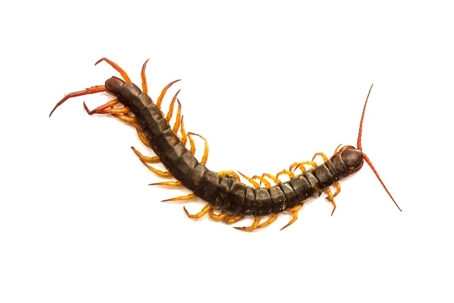
How To Get Rid Of Centipedes
If someone wants to get rid of centipedes on their own, the best approach is to focus on eliminating what attracts them in the first place: moisture, food sources (other insects), and hiding spots. Centipedes don’t actually infest in large numbers like roaches or ants, but they show up where the environment is ideal for them. Here’s how to get rid of centipedes:
Reduce Moisture
Reducing moisture is one of the most effective ways to control centipedes because it directly targets the environmental conditions they depend on to survive and hunt. Centipedes are highly moisture-dependent arthropods with thin exoskeletons that lose water easily, so they are naturally drawn to humid, damp, and poorly ventilated areas where dehydration risk is low and prey is abundant.
When moisture levels are high—such as in basements, crawl spaces, bathrooms, utility rooms, or around leaking plumbing—these areas also tend to support large populations of insects like silverfish, ants, cockroaches, and small fly larvae, which are the centipede’s primary food source. By reducing moisture, you disrupt both sides of this equation: you make the environment physiologically unsuitable for centipedes and simultaneously reduce the insect prey base that keeps them present.
Moisture reduction also forces centipedes to leave sheltered indoor habitats. Drying out spaces through improved ventilation, dehumidification, and repair of leaks makes conditions less stable for them, increasing desiccation stress. As a result, centipedes are more likely to move outdoors where humidity is more consistent or die off if they cannot find suitable microhabitats.
Key moisture-control actions include fixing plumbing leaks, improving drainage around foundations, using dehumidifiers in basements or crawl spaces, ensuring proper ventilation in bathrooms and attics, and eliminating standing water sources such as clogged gutters or poorly graded soil. Sealing gaps and cracks also helps by reducing humid air exchange and limiting entry points from damp exterior zones.
In practical pest management terms, moisture control is especially important because centipedes are typically secondary invaders, meaning they are present primarily because the environment supports their prey. Once moisture is reduced, both prey populations and centipede survival rates decline, leading to a noticeable drop in activity over time without needing heavy reliance on chemical treatments.
Remove Hiding Places
Removing hiding places helps eliminate centipedes by reducing the stable, protected microhabitats they rely on for daytime survival, hunting strategy, and moisture retention. Centipedes are nocturnal predators that spend most of the day concealed in dark, tight, and humid spaces where they are protected from desiccation and disturbance. Common hiding sites include cracks in foundations, cluttered storage areas, cardboard piles, leaf litter, mulch beds, wall voids, baseboard gaps, and spaces under appliances or stored materials.
When these hiding places are removed or significantly reduced, centipedes lose the structural cover they depend on to avoid dehydration and predators. Unlike some pests that can survive in open environments, centipedes have a relatively high water-loss rate and thin exoskeleton, so they require sheltered environments that maintain humidity. Without those refuges, they are forced into exposed areas where they are more likely to dry out, be removed during cleaning, or be intercepted by natural predators.
Removing clutter and debris also disrupts their hunting efficiency. Centipedes are ambush predators that rely on tight, concealed pathways to capture insects. When hiding places are eliminated—such as stacked boxes on floors, dense landscaping mulch against foundations, or unmanaged storage—they lose the structural complexity needed to effectively hunt, which reduces their ability to sustain themselves indoors or near buildings.
In addition, reducing harborage sites helps break the connection between centipedes and their food supply. Many hiding areas overlap with insect activity zones (cockroaches, ants, silverfish), so when those areas are cleaned, sealed, or reorganized, both prey and predator populations decline together. This is especially important in basements, crawl spaces, and utility rooms where moisture and clutter often combine to create ideal conditions.
Practical steps include decluttering storage areas, elevating stored items off the floor, sealing cracks and gaps in foundations and baseboards, reducing mulch depth near building edges, removing leaf litter and organic debris, and organizing materials so there are fewer voids and sheltered pockets. Outdoor structural changes, such as trimming vegetation away from walls and improving drainage, further reduce external harborage that feeds indoor movement.
Removing hiding places works because it removes the structural safety net centipedes depend on for moisture retention, concealment, and hunting, forcing them into less survivable conditions and significantly reducing their ability to persist in and around human structures.
Eliminate Food Sources
Eliminating food sources helps reduce centipedes because it targets their primary biological driver for staying in a given area: prey availability. Centipedes are obligate predators, meaning they must actively hunt other small arthropods to survive. Their most common prey in and around structures includes cockroaches, ants, silverfish, termites, small spiders, fly larvae, and other moisture-loving insects. If those prey populations are abundant, centipedes are able to establish and persist even if conditions are otherwise marginal.
When food sources are removed, centipedes experience a rapid decline in habitat suitability, because even if moisture and shelter are available, they cannot sustain themselves without consistent prey. This causes two key outcomes: first, existing centipedes often leave the area in search of better hunting grounds, and second, reproduction and survival rates drop because adults cannot reliably feed themselves or their offspring.
Food reduction also has an indirect effect by disrupting the moisture-insect-centipede cycle. Many of the insects centipedes feed on thrive in damp, cluttered environments with organic debris, leaks, or poor sanitation. By controlling these conditions—cleaning food residue, fixing moisture issues, sealing trash, and reducing organic buildup—you suppress the insect populations that form the centipede’s food base. As prey density drops, centipedes are no longer able to establish stable hunting territories indoors or near building foundations.
Another important effect is behavioral. Centipedes are opportunistic but localized hunters, meaning they typically remain close to reliable food sources rather than roaming widely. When prey becomes scarce, they are forced to expend more energy searching, which increases exposure to dry conditions and predators and makes the environment less viable overall.
Food elimination is most effective when paired with moisture control and harborage reduction, because centipedes rarely persist in areas that lack both prey and stable hiding conditions. Together, these changes collapse the three core requirements for centipede survival: food, moisture, and shelter, leading to long-term reduction in activity rather than temporary displacement.
Seal Entry Points
Sealing entry points helps reduce centipede problems by blocking the pathways they use to move between outdoor harborage areas and indoor environments where moisture and prey are available. Centipedes do not typically establish large indoor colonies; instead, they enter structures through small gaps while following insects or seeking damp, sheltered conditions. Common entry routes include cracks in foundations, gaps under doors, utility penetrations, weep holes, torn window or vent screens, and unsealed expansion joints.
When these openings are sealed, you interrupt their ability to recolonize indoor spaces after being removed or disturbed outdoors. Even if centipedes are eliminated inside a structure, they can quickly re-enter from exterior environments if access points remain open. Sealing creates a physical barrier that forces them to remain outside, where environmental conditions are generally more variable and less consistently favorable than inside a building.
Sealing also reduces the movement of their prey species, which is a key indirect effect. Many insects that centipedes feed on—such as ants, cockroaches, and small flies—also exploit entry points and structural gaps. By closing these openings, you limit both predator and prey movement into indoor spaces, reducing the overall food web that supports centipede presence.
Another important benefit is that sealing helps stabilize indoor environmental conditions, particularly humidity. Open gaps allow moist exterior air to enter basements, crawl spaces, and wall voids, creating microclimates that centipedes prefer. Proper sealing reduces air exchange and helps maintain drier, less favorable conditions indoors.
Sealing entry points is most effective when combined with moisture control, sanitation, and insect reduction, because it does not eliminate centipedes already present outside or in nearby soil and landscaping. However, it is a critical long-term step because it prevents repeated reinvasion, which is often what makes centipede problems seem persistent even after initial removal efforts.
Trapping & Direct Removal
The most effective way to trap and directly remove centipedes indoors is to use a combination of targeted interception trapping, nighttime active capture, and strategic placement near harborage zones, since centipedes are not strongly attracted to bait and must be intercepted rather than lured.
The most reliable trapping tool is the glue trap (sticky board). These work because centipedes actively travel along walls and baseboards while hunting, especially at night. Placement is critical: traps should be set flush against vertical surfaces, particularly along baseboards, behind appliances, under sinks, inside closets, near bathroom fixtures, in basements, crawl space entries, and along foundation walls where insects are present. Corners are especially productive because centipedes naturally funnel through these tight travel paths. For best results, use multiple traps per room rather than isolated placement, and check them frequently since centipedes can sometimes struggle or partially escape if traps become overloaded with dust or debris.
A second effective method is manual nighttime removal, which is often the fastest way to directly reduce visible populations. Centipedes are nocturnal hunters, so using a flashlight after dark in bathrooms, kitchens, basements, or along walls allows you to locate and remove them individually. Mechanical capture tools such as long-handled tweezers, tongs, or a vacuum with a hose attachment are commonly used for quick removal. Vacuuming is especially effective because it immediately removes the centipede and can capture individuals hiding in small cracks or along edges.
For enhanced trapping efficiency, it helps to pair traps with attractant conditions that centipedes naturally follow, not bait. That means placing traps near areas with higher insect activity (since centipedes are predators), such as around drains, near moisture sources, or close to exterior entry points where other insects enter. The goal is interception along their hunting routes, not feeding attraction.
Environmental context matters as well: trapping works best when combined with moisture reduction and insect control, because centipedes tend to concentrate in areas where prey is abundant and humidity is stable. Without addressing those conditions, traps may capture individuals but will not significantly reduce long-term activity.
Exterior Perimeter Treatment
An exterior perimeter treatment helps reduce centipede activity indoors by intercepting them at the building’s outer boundary and reducing the population pressure around the structure before they ever find entry points or indoor harborage conditions. Centipedes typically live outdoors in soil, mulch, leaf litter, wood debris, and under stones, then move toward buildings when moisture, temperature, or prey conditions are favorable. By treating the perimeter, you create a chemical or residual barrier zone that disrupts this movement pattern and lowers the number of centipedes reaching the structure.
In practice, perimeter treatments are usually applied as a banded application along the foundation, around entry points, and in key transition zones such as door thresholds, utility penetrations, and areas where landscaping meets the building. The products used (typically residual insecticides labeled for perimeter pest control) work by either repelling centipedes or affecting them through contact as they cross treated surfaces. This reduces their ability to reach cracks, gaps, and wall voids where they would otherwise enter.
A major indirect benefit is that perimeter treatments also reduce centipede prey populations near the structure. Many of the insects centipedes feed on—such as ants, cockroaches, and small ground-dwelling arthropods—are also active in the same exterior zones. When those populations are reduced, the food supply that attracts centipedes to the building decreases, making the area less attractive overall.
Perimeter treatments are especially effective when combined with habitat modification, such as removing leaf litter, reducing mulch depth near foundations, trimming vegetation away from walls, and improving drainage so soil does not remain consistently damp. Without these changes, treatments may be less effective because centipedes can still thrive in untreated microhabitats nearby and reattempt entry.
Centipedes are continuous outdoor inhabitants, so perimeter treatments are not a one-time solution—they function best as part of a maintenance barrier that is periodically refreshed, especially during warm, humid seasons when activity is highest.
Interior Targeted Treatment
If additional control is needed, the safest chemical option indoors is targeted use of low-toxicity, labeled products in crack-and-crevice applications only, such as insecticidal dusts placed in wall voids, behind appliances, or along hidden entry points. These should not be broadly sprayed across living areas. The goal is to treat harborage zones, not open surfaces, which minimizes exposure risk to people and pets.
What should be avoided for safety indoors are broad aerosol sprays, foggers, or widespread chemical applications, which are not necessary for centipedes and can expose occupants to more chemical residue without addressing the root cause.
The key to long-term success is reducing the moisture and insect prey that attract them. If you just kill the centipedes you see without fixing the conditions, new ones will keep moving in.
The Best Way To Get Rid Of Centipedes
Our exterminators are the best way to get rid of a centipede infestation because we go far beyond simply killing the few centipedes you see. Our professional pest control services target the underlying conditions that allow centipedes to thrive and ensures the problem is solved at its source. Here's how:
- Accurate Identification and Inspection: Our exterminators don’t just confirm centipedes are present—we identify why they are there. Since centipedes are predators, their presence usually means there are other insect populations hiding in your home. Our professionals trace centipede activity back to the root cause, such as moisture issues, cracks in the foundation, or underlying infestations of ants, roaches, or spiders.
- Targeted Treatment Strategies: Store-bought sprays or traps only offer temporary relief. Our exterminators use professional-grade products that are stronger, longer-lasting, and precisely applied in areas where centipedes hide and breed. We may also use insect growth regulators (IGRs) and dust treatments in wall voids or crawl spaces—places most homeowners can’t safely or effectively treat.
- Comprehensive Pest Elimination: Centipedes feed on other insects. If those insects remain in your home, new centipedes will keep coming. Our exterminators take an integrated approach: we eliminate not only centipedes but also the pests that attract them, providing lasting results.
- Moisture and Habitat Control: Our professionals don’t just spray and leave; we help address the conditions centipedes thrive in. This may include identifying drainage issues, sealing entry points, recommending dehumidifiers, and reducing outdoor harborage areas such as mulch, woodpiles, and leaf litter.
- Safety and Precision: DIY insecticides can be misused, leading to health risks for pets, children, and adults. Our exterminators are trained in safe, targeted applications that minimize exposure while maximizing effectiveness.
- Long-Term Prevention: We provide ongoing maintenance plans. This means regular inspections and preventative treatments that stop centipedes—and the insects they prey on—from returning.
- Peace of Mind: Instead of constantly worrying about when and where you’ll see another centipede, our professional pest control gives you confidence that the infestation is handled and your home is protected.
Our exterminators are the best solution because we don’t just kill centipedes—we eliminate the hidden insect populations, moisture issues, and entry points that make your home attractive to them.
Get Rid Of Centipedes With Miche Pest Control
Hiring our team of professionals at Miche Pest Control is an investment in long-term protection, expertise, and peace of mind. Here’s why:
- Personalized Service and Local Expertise: We know the specific pest pressures in the area. Our technicians understand the environment, climate, and building types common to the area, allowing them to provide targeted, effective treatments.
- High-Quality, Comprehensive Solutions: As a full-service provider, we don’t just treat surface problems; we address the root causes. From inspections and prevention to exclusion and ongoing maintenance, we deliver complete, integrated pest management (IPM) programs designed to both eliminate infestations and prevent future ones.
- Accountability and Reliability: We live and die by our reputation. We rely on trust, referrals, and repeat business, meaning we're committed to doing the job right the first time and providing exceptional customer care.
- Faster Response Times: We respond quickly to emergencies and schedule services sooner than large, national chains. Especially when you’re dealing with urgent pest issues, that speed matters.
- Customized Treatment Plans: We tailor our services to your property’s specific needs instead of using one-size-fits-all chemical treatments. This results in safer, more effective pest control that minimizes environmental impact and reduces unnecessary pesticide use.
- Highly Trained, Experienced Technicians: We invest in training, certification, and continuing education for our technicians. We stay current on the latest pest biology, control techniques, and safety standards.
- Long-Term Prevention and Value: Our focus on providing quality service means fewer callbacks, longer-lasting protection, and better value over time. Instead of repeated, temporary fixes, you get strategic solutions that protect your home or business for the long run and provide better peace of mind.
Hiring our team means you get expertise you can trust, faster service, safer and more effective treatments, and long-term results that protect both your property and your peace of mind. Contact us today!