
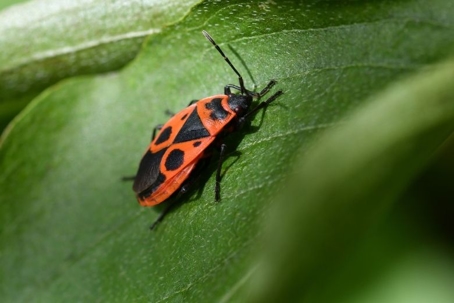
What Do Bugs Eat?
True bugs (order Hemiptera) have piercing–sucking mouthparts, so they feed by tapping into fluids rather than chewing solid material. What they eat varies by family, but most fall into a few clear categories.
Many species are strictly plant feeders. They draw sap from leaves, stems, fruits and seeds, which can lead to wilting, leaf distortion, spotting and, in high numbers, significant crop or ornamental damage. Aphids, leafhoppers, stink bugs and squash bugs fall into this group. Their diet is primarily phloem or xylem sap, though some will also probe developing fruit for nutrient-rich juices.
Other groups are predatory. Assassin bugs, minute pirate bugs, and some Nabids actively hunt soft-bodied arthropods such as caterpillars, beetle larvae, aphids, mites and other small insects. They use their rostrum to inject enzymes that immobilize and liquefy the prey before feeding. These species are often beneficial in gardens and agricultural systems.
A smaller subset is omnivorous, feeding opportunistically on both plant juices and small insects depending on availability. Some stink bugs and lace bugs show this flexibility.
A few species are blood feeders—most notably bed bugs, kissing bugs, and bat bugs. Their diet consists exclusively of blood from humans or animals, which they obtain through nocturnal feeding.
Their feeding tendencies depend heavily on the specific family, but the unifying theme is fluid extraction—plant sap, insect hemolymph or vertebrate blood—accessed through specialized mouthparts.
Do Bugs Eat Plants?
True bugs that feed on plants—often called phytophagous Hemiptera—tend to target species that provide easily accessible, nutrient-rich sap, especially from phloem or xylem. The specific plants vary by the bug family, but there are clear patterns:
- Aphids (Aphidoidea): Favor tender, young plant tissues, especially new leaves and shoots. Common hosts include vegetables (lettuce, cabbage, broccoli), legumes (beans, peas), fruit trees (apple, peach, cherry), and ornamentals (roses, chrysanthemums). They tend to congregate on undersides of leaves and buds where sap pressure is highest.
- Leafhoppers (Cicadellidae): Feed on grasses, cereals (corn, wheat, rice), and herbaceous plants. Many specialize: some feed mainly on monocots like grasses, others on dicots like grapes or potatoes. Can vector plant pathogens as they feed.
- Stink bugs (Pentatomidae) – plant-feeding species: Often attack fruit and seed-bearing plants. Examples: tomatoes, peppers, soybeans, cotton, apples, peaches, and various legumes. They pierce fruit or seeds, sucking juices and sometimes causing cosmetic or structural damage.
- Scale insects, mealybugs, and whiteflies (Coccoidea & Aleyrodidae): Target woody shrubs, fruit trees, and greenhouse crops. Common hosts: citrus, grapes, hibiscus, poinsettias, and indoor houseplants. These bugs often cluster on stems, leaf veins, or fruit undersides, producing honeydew that can lead to sooty mold.
- Sap-sucking bugs on ornamentals: Examples include lace bugs (Tingidae) on azaleas, rhododendrons, sycamores, and hawthorns. These bugs feed primarily on the underside of leaves, leaving a stippled or bleached appearance.
True bugs are attracted to soft, actively growing tissue with high nutrient content. Some are highly specialized, feeding on a narrow plant family; others are generalists. Fruit, seeds, young leaves, and buds are consistently preferred over mature, tough tissues.
Do Bugs Eat Wood?
Among the true bugs (Hemiptera), none are true wood-eaters in the way termites or wood-boring beetles are. Their mouthparts are designed for piercing and sucking fluids, not grinding or digesting solid material, and they lack the microbial symbionts required to break down cellulose or lignin.
Here’s what actually happens with true bugs around wood: they do not consume wood, but some feed on the sap inside woody plants. These species tap into xylem or phloem in trunks, branches or twigs, but they are extracting liquid—not ingesting any structural wood. Examples include:
Cicadas – nymphs feed on xylem sap from tree roots.
Spittlebugs / leafhoppers / planthoppers – feed on sap from stems, twigs or leaves.
Some stink bugs – probe fruits, seeds and occasionally twigs, but again only accessing juices.
Aphids on trees – tap phloem in woody ornamentals and fruit trees.
No true bug species bores into or feeds on solid wood. You won’t find Hemiptera doing the kind of damage caused by termites, carpenter ants, carpenter bees, longhorn beetle larvae, powderpost beetles or other true wood-feeders.
So while many true bugs feed on trees, they are feeding on sap, not on the wood itself.
Do Bugs Eat Insects?
Predatory true bugs—especially assassin bugs, damsel bugs, minute pirate bugs, big-eyed bugs, and certain predatory stink bugs—tend to focus on soft-bodied or slow-moving arthropods that are easy to pierce with their rostrum. Their prey choices follow consistent patterns across habitats:
- Predatory bugs commonly target aphids, which are abundant, immobile, and rich in fluids.
- Caterpillars, particularly early instars, are another major food source because their thin cuticle is easy to penetrate.
- Mites, including spider mites, are frequent prey for the smallest predatory species such as minute pirate bugs.
- Many also feed on thrips, whitefly nymphs, and psyllids, tapping their hemolymph directly.
- Some medium-sized predators pursue leafhopper nymphs, plant bug nymphs, and small beetle larvae
- Larger assassin bugs will subdue bees, wasps, flies, crickets, and even other true bugs when the opportunity presents itself.
- Cannibalism, while not routine, does occur when prey is scarce.
Across all these groups, the unifying theme is accessible body fluids. They favor prey with minimal defensive structures, soft exoskeletons, and predictable clustering behavior, which lets them ambush or stalk with minimal energy expenditure.
Do Bugs Eat Blood?
Several groups of blood-feeding bugs exist, but only a small portion of the true bug order (Hemiptera) relies on vertebrate blood. The species most closely associated with blood meals fall into three main categories:
- Bed bugs (Cimicidae): These include the common bed bug (Cimex lectularius) and the tropical bed bug (Cimex hemipterus). They feed exclusively on human or animal blood, typically at night. Their flattened bodies let them hide in tight cracks near sleeping areas, and their feeding produces small, clustered welts on many individuals.
- Bat bugs and bird bugs (related Cimicidae species): Bat bugs resemble bed bugs but normally feed on bats; bird bugs feed on nesting birds such as swallows or pigeons. When their primary hosts are absent, they may wander indoors and bite humans, but they do not infest homes as reliably as bed bugs.
- Kissing bugs / conenose bugs (Triatominae): These larger true bugs feed on the blood of mammals, birds and reptiles. In the U.S., kissing bugs are found mostly in the South and Southwest and often take blood meals from outdoor host animals. They typically bite sleeping hosts around the face, which gives them their common name.
Beyond the true bugs, several non-Hemipteran arthropods routinely feed on blood. Mosquitoes, fleas, ticks, biting midges, black flies and lice are the most familiar examples. All share specialized mouthparts for piercing skin and accessing blood, and their feeding habits help explain why they serve as vectors for many pathogens.
Across all these groups, the defining trait is a biological dependence on vertebrate blood for energy or reproduction, supported by mouthparts and behaviors adapted to find and exploit suitable hosts.