Daddy Long Legs
Are Daddy Long Legs Harmful?
Harvestmen (commonly called “daddy longlegs,” though not to be confused with cellar spiders or other spiders with similar nicknames) are generally considered harmless to humans. They don’t have venom glands, cannot bite humans, and aren’t known to transmit diseases. However, there are a few ways they might be considered harmful, though these are mostly indirect or situational:
- Nuisance infestations: Large numbers of harvestmen gathering in homes, garages, or sheds can become a nuisance. They tend to congregate in dark, damp areas, which can make a space feel unsanitary or crowded. While they don’t damage property, their presence can be unsettling.
- Damage to plants: Although they are mostly scavengers feeding on decaying plant and animal matter, some species will occasionally feed on tender plants, flowers, or seedlings. In small numbers, this damage is negligible, but in rare cases, large populations could slightly harm garden plants.
- Predation on beneficial insects: Harvestmen are generalist feeders and will eat small insects. While this can be beneficial by controlling pests, they may also consume pollinators or other beneficial arthropods, though this effect is usually minor.
- Attracting secondary pests: Dead harvestmen can attract scavengers like ants or beetles into your home. Additionally, their excretions or decaying bodies may contribute to minor odor problems if infestations are heavy.
- Psychological impact: For people with arachnophobia or general fear of insects, even harmless harvestmen can cause stress or anxiety, which is a form of “harm” in a psychological sense.
Harvestmen are more beneficial than harmful in most ecosystems, as they help break down organic matter and control small insect populations. Their “harmful” effects are largely situational and not intrinsic.
Learn more: Do Daddy Long Legs Bite? || Are Daddy Long Legs Venomous? || What Do Daddy Long Legs Eat?
Daddy Long Legs Removal
Daddy long legs, or harvestmen, can be more than just an odd sight in your home—they can become a nuisance or even a concern in certain contexts. While they are generally not dangerous to humans (they do not have venom glands like spiders and cannot bite in a harmful way), there are several reasons why controlling or removing them can be important, especially for homeowners or businesses:
- Infestation Potential: Harvestmen reproduce relatively quickly and can appear in large numbers if conditions are favorable—damp, dark areas with access to food like small insects and organic matter. A sudden proliferation can make your home or property unsightly and harder to manage.
- Food Source for Other Pests: While harvestmen themselves are generally harmless, they can attract other pests or predators, including spiders, centipedes, and other arthropods. This could create a secondary pest problem within the property.
- Sanitation and Allergens: Harvestmen feed on decomposing organic matter and small insects, which can include pests such as flies or mites. Their presence in large numbers may indicate underlying sanitation or moisture issues. Dead harvestmen, shed exoskeletons, and droppings can accumulate, potentially contributing to indoor allergens and dust.
- Structural Habitats: Harvestmen tend to hide in cracks, crevices, basements, crawlspaces, and other dark areas. Their presence can indicate dampness, decay, or structural gaps that may allow other pests or moisture problems to enter, which can lead to more serious property damage if unaddressed.
- Perception and Psychological Impact: Many homeowners and employees find clusters of long-legged arachnids disturbing, even if they are harmless. Controlling them maintains a clean, pest-free appearance, which is particularly important in commercial environments or high-traffic homes.
- Potential Damage to Plants or Gardens: While harvestmen mostly eat small insects and decaying matter, they occasionally feed on soft plant tissue or fruits. In gardens or agricultural settings, large populations can cause minor damage to seedlings or produce.
While daddy long legs themselves aren’t venomous or directly harmful to humans, their presence often signals environmental conditions that favor pests, structural vulnerabilities, or hygiene concerns. For these reasons, our professional control can prevent escalation into larger infestations or secondary problems.
Learn more: How To Get Rid Of Daddy Long Legs
Daddy Long Legs Control
Hiring our professional pest control for daddy long legs (harvestmen) may seem unnecessary to some because these arachnids are generally harmless—they don’t bite humans, don’t have venom dangerous to humans, and aren’t typically aggressive. However, there are several reasons why our professional control can still be beneficial, especially if you are experiencing a larger infestation:
- Effective Population Reduction: Harvestmen can appear in large numbers indoors or in basements, garages, and crawl spaces. While they don’t pose direct health risks, their presence can be unsettling. Our professionals have the expertise and tools to reduce populations efficiently, often using integrated pest management (IPM) strategies that minimize recurrence.
- Prevention of Structural Nuisance: Harvestmen often cluster around foundations, windows, and in corners of buildings. Over time, this can create a visible nuisance with cobweb-like residues and dead bodies, which can be difficult to clean. Our professionals can identify hotspots and treat areas that homeowners might overlook, reducing the likelihood of ongoing infestations.
- Comprehensive Habitat Treatment: Our professionals don’t just target spiders themselves—we also address environmental conditions that attract them. This includes sealing entry points, reducing moisture, clearing debris, and treating perimeter areas, which ensures a long-term reduction rather than just a temporary fix.
- Safe and Targeted Application of Treatments: Even if you prefer chemical control, our professionals have access to more effective, targeted products and know safe application techniques. This reduces risks to pets, children, and beneficial insects, which can often be affected by improper DIY treatments.
- Time and Hassle Savings: Managing a harvestmen infestation can be tedious and time-consuming. Our professionals provide fast, thorough service and monitor the situation afterward to ensure the infestation doesn’t return.
- Identification and Monitoring: Some “daddy long legs” sightings are actually cellar spiders or other arachnids. Our professionals can correctly identify the species, so you aren’t wasting effort treating harmless or misidentified spiders with the wrong methods.
While harvestmen aren’t medically dangerous, our professional pest control services ensure that your home remains spider-free in a safe, efficient, and long-lasting way, especially if the infestation is large or recurring. It’s less about danger and more about comfort, cleanliness, and prevention.
Daddy Long Legs Exterminators
Hiring our local exterminators instead of a national chain for controlling daddy long legs (harvestmen) has several tangible advantages, especially if your goal is thorough, long-lasting results. Here’s why:
- Local Expertise and Knowledge: Our local exterminators have a deep understanding of the pests in the area, including seasonal population trends, preferred habitats, and how the local climate affects their behavior. This includes knowing where harvestmen are likely to hide, where they overwinter, and how landscaping or nearby vegetation influences infestations—insights that national companies often overlook.
- Customized, Property-Specific Solutions: Harvestmen infestations are rarely the same from one property to another. Our local professionals conduct thorough inspections to identify moisture hotspots, entry points, and environmental conditions attracting these pests. This allows us to develop treatment plans tailored specifically to your building and yard. National companies often rely on standardized protocols, which often treat only the symptoms rather than the underlying causes.
- Rapid Response Time: Our local exterminators can often schedule service faster and respond to follow-up visits promptly. If the infestation persists or recurs, our local technicians can return quickly and adjust our treatment strategies based on firsthand observations. National chains often operate on fixed schedules, which can slow down effective control.
- Personalized Attention and Accountability: Our local team emphasizes direct customer relationships. We provide and honor our guarantees, provide detailed explanations, and provide information for our clients on relevant pest prevention strategies. You interact directly with our technicians and small team of office staff, which reduces miscommunication and ensures accountability, unlike national chains where communication is done through national call centers.
- Cost Efficiency: Our precise, property-specific treatments require fewer repeat visits and reduce unnecessary chemical use, saving money over time. In contrast, national chains often charge more for standardized treatments that don’t always fully resolve the problem.
- Integrated Pest Management (IPM) Approach: Our experienced local professionals implement IPM strategies, which focus on long-term prevention rather than just elimination. This includes sealing cracks and entry points, making moisture control recommendations for basements or crawlspaces, and managing vegetation near the foundation. National companies typically rely mainly on spraying, which may provide temporary relief but doesn't address the environmental factors that attract harvestmen to begin with.
- Community Knowledge: Our local exterminators know which neighborhoods and property types are more prone to harvestmen infestations and provide proactive advice to help prevent future problems. National companies do not have this localized insight, making long-term prevention less effective.
Our local exterminators combine fast, customized service with regional knowledge and personal accountability, making us far more effective at eliminating harvestmen and preventing their recurrence. National companies and their cookie-cutter approaches often miss the nuances that control these pests long-term.
Daddy Long Legs Solutions
Our exterminators use Integrated Pest Management (IPM) to control harvestmen because while these arachnids are generally harmless, they can become a nuisance when they congregate in homes, garages, or other structures in large numbers. IPM begins with a thorough inspection to identify areas of activity, entry points, and environmental factors that attract them, such as moisture, clutter, and abundant insect prey. Management strategies focus on habitat modification by reducing moisture, sealing cracks and gaps, removing clutter, and limiting insect populations to make areas less hospitable for harvestmen. Physical controls, including careful removal and exclusion measures, are used to minimize indoor presence, while chemical treatments are applied selectively only in areas of persistent activity. Ongoing monitoring allows our exterminators to track populations, assess the effectiveness of control measures, and prevent reinfestation. By integrating inspection, habitat modification, selective control, and monitoring, IPM provides a long-term, safe, and environmentally responsible approach to managing harvestmen populations.
What Do Daddy Long Legs Look Like?
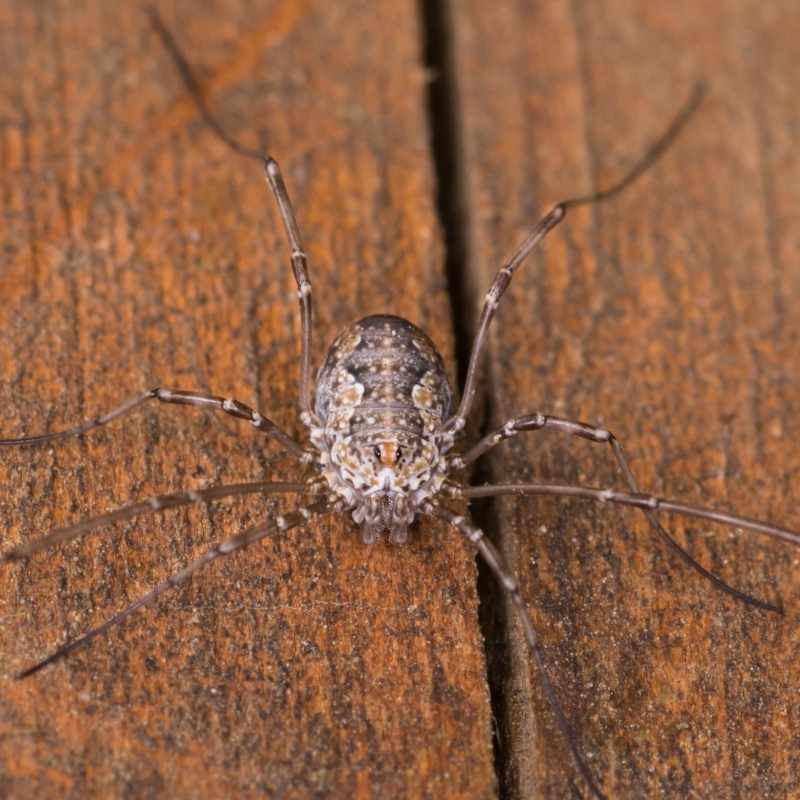
Daddy longlegs, also known as harvestmen, are arachnids that are often mistaken for true spiders. They have distinct characteristics that set them apart:
- Body Shape: Daddy longlegs have a small, round body that is segmented into two main parts: the cephalothorax (combined head and thorax) and the abdomen. Unlike true spiders, they lack a distinct waist or narrow connection between these body parts.
- Legs: Harvestmen have exceptionally long and thin legs, which is how they get their common name. The legs can be up to several times the length of their body. Each leg typically has seven segments, giving them a spindly appearance.
- Coloration: Daddy longlegs come in various colors, including brown, gray, or even a pale yellowish hue. Their coloring helps them blend into their environment.
- Eyes: Unlike spiders, daddy longlegs have small, simple eyes arranged in a cluster on top of their cephalothorax. They lack the specialized vision of true spiders.
- No Venom or Silk: Daddy longlegs do not possess venom glands or silk-producing spinnerets, which are characteristic features of true spiders. They are not considered dangerous to humans.
- Antennae: Some species of daddy longlegs have long, whip-like antennae that extend from their heads.
While daddy longlegs are arachnids and may resemble spiders at a glance, they belong to a different order called Opiliones, whereas true spiders belong to the order Araneae. Daddy longlegs are not venomous and are primarily scavengers, feeding on small insects and detritus. They are often found in damp environments, such as forests, gardens, and basements, where they play a role in controlling insect populations.
Where Are Daddy Long Legs Found?
Daddy longlegs, also known as harvestmen, can be found in a variety of habitats, primarily in temperate regions around the world. Here are some common places where you might encounter daddy longlegs spiders:
- Wooded Areas: Daddy longlegs are often found in forests and wooded areas. They prefer the damp and shaded environment provided by leaf litter, fallen logs, and undergrowth.
- Gardens and Parks: Harvestmen can also be spotted in gardens, parks, and other green spaces. They may hide among plants, shrubs, and in garden mulch.
- Basements and Crawlspaces: In urban and suburban areas, daddy longlegs can sometimes be found in damp basements, crawlspaces, or dark corners of buildings. They are attracted to cool, moist environments.
- Fields and Grasslands: In more open environments like fields and grasslands, daddy longlegs can be found in tall grasses and among rocks and debris.
- Moist Coastal Areas: Some species of daddy longlegs are adapted to coastal habitats and can be found along the shorelines, particularly in areas with ample vegetation.
- Caves and Crevices: In certain regions, daddy longlegs can be found in caves and rocky crevices, where they seek shelter and moisture.
- Rainforests: In tropical rainforests, you may find a variety of harvestmen species inhabiting the forest floor, vegetation, and the lower levels of the canopy.
- Human Structures: As mentioned earlier, daddy longlegs can occasionally find their way into buildings, especially if there is a source of moisture and darkness.
Daddy longlegs are typically harmless to humans and are beneficial in natural ecosystems as they feed on small insects and decaying organic matter. If you want to observe them, look in these types of habitats, especially in the evening when they become more active. Keep in mind that they are sensitive to changes in their environment, so handle them with care if you decide to pick one up.
Daddy Long Legs Life Cycle
The life cycle of daddy longlegs, scientifically known as harvestmen (Order: Opiliones), is relatively simple compared to some other arachnid species. It typically consists of several stages, including egg, nymph, and adult, without the complex metamorphosis seen in some insects. Here is an overview of their life cycle:
- Egg Stage: Daddy longlegs reproduce sexually. The female lays a clutch of eggs, often in damp or sheltered locations, such as under rocks, logs, or in leaf litter. The eggs are usually attached to a substrate with a sticky substance produced by the female.
- Nymph Stage: After a period of incubation, the eggs hatch into nymphs. These nymphs closely resemble miniature versions of adult daddy longlegs but lack the full adult characteristics. Nymphs have fewer segments on their legs, and their bodies may be more proportionate compared to the long-legged appearance of adults. They undergo a series of molts as they grow, shedding their exoskeleton to accommodate their increasing size. Nymphs feed on small insects, tiny invertebrates, and detritus found in their environment.
- Adult Stage: Once the nymphs have undergone enough molts and reached maturity, they become adult daddy longlegs. Adult harvestmen have the characteristic long, slender legs and segmented body with a cephalothorax and abdomen. They continue to feed on small insects and decaying organic matter. Unlike some other arachnids, daddy longlegs do not produce silk or build webs for catching prey.
- Reproduction: During the appropriate season, adult male and female daddy longlegs engage in courtship rituals, which may involve the male offering food or performing certain movements to attract the female. After successful courtship, mating occurs, and the female may lay another batch of eggs in a suitable location.
- Lifespan: The lifespan of adult daddy longlegs can vary among species, but it is relatively short, typically ranging from a few months to a year or so, depending on environmental conditions and predation pressures.
Daddy longlegs are not true spiders (Order: Araneae), and their life cycle differs from that of spiders, which often include a more distinct larval stage and complex metamorphosis. Daddy longlegs primarily play roles in scavenging and helping to decompose organic matter in their ecosystems, contributing to nutrient recycling in various habitats.
Hear From Our Happy Customers
-
"Wonderful Service"
Wonderful service. Jarvis is great. Took care of everything I needed. Thank you!
- Henry P. -
"Professional & Considerate"
I’m pleased with Miche services. Jarvis came today. Professional and considerate. Thank you!
- Judy B. -
"Great Communication"
Tech was on time, communication was great, and he accommodated my needs.
- Alonzo W. -
"Exceeds Expectations"
I can’t say enough positive things about this company... The tech that came out, Jarvis went above and beyond my expectations. Thank you guys, I will continue using your services.
- Jake M. -
"Very Knowledgeable"
The tech that arrived was courteous, professional, and very knowledgeable. He was Great.
- Uerial I. -
"Fantastic & Patient"
Jarvis was fantastic and patient. He answered my questions with an in-depth explanation and addressed all of my areas of concern. Would love for him to be my assigned tech going forward. Well done!
- Yonnette M.