
How Long Do Stink Bugs Live?
Most stink bugs live between six and ten months, although lifespan varies depending on environmental conditions. In warmer climates or protected indoor settings, some individuals can survive close to a full year. After hatching from eggs in about four to seven days, stink bugs develop through five nymph stages over a period of four to six weeks before reaching adulthood. Once mature, they live for several additional months. Many species, particularly the brown marmorated stink bug commonly found in homes, extend their survival by overwintering. During fall, adults seek shelter inside buildings, wall voids, or other protected areas where they enter a dormant state and can live for months without feeding. This extended survival period explains why these bugs are often present indoors from fall through early spring and why infestations can seem persistent even when active feeding is not occurring.
How Do Stink Bugs Reproduce?
Stink bugs reproduce through a typical insect mating process that occurs during warm months when temperatures and food sources are favorable. After overwintering, adults become active in spring and mate, with females laying clusters of barrel-shaped eggs on the undersides of leaves or other sheltered surfaces. Each egg mass usually contains about 20 to 30 eggs, and a single female can lay several hundred eggs over her lifetime. The eggs hatch within four to seven days, producing nymphs that immediately begin feeding on plants. These nymphs go through five developmental stages, gradually increasing in size before becoming adults. Under favorable conditions, this reproductive cycle allows stink bug populations to grow rapidly, which is why infestations often peak in late summer and early fall.
Do Stink Bugs Lay Eggs?
Yes, stink bugs lay eggs as part of their normal life cycle. After mating, females deposit clusters of small, barrel-shaped eggs—typically 20 to 30 at a time—on the undersides of leaves or other protected surfaces, where they hatch within about a week.
Stink Bug Life Cycle
Stink bugs go through a simple life cycle consisting of egg, nymph, and adult stages. Females lay clusters of eggs on protected surfaces, which hatch in about four to seven days. The young nymphs pass through five growth stages over several weeks before becoming adults that live for several months and reproduce.
Stink Bug Eggs
Stink bug eggs are the initial stage of the insect’s life cycle and play a crucial role in population growth. After mating, female stink bugs lay clusters of small, barrel-shaped eggs on the undersides of leaves or other sheltered surfaces. These eggs typically hatch within four to seven days, releasing nymphs that immediately begin feeding and developing. The eggs mark the beginning of the nymphal stages, which go through five molts before reaching adulthood. Without successful egg laying and hatching, the subsequent nymph and adult stages would not occur, making the egg stage essential for sustaining and expanding stink bug populations.
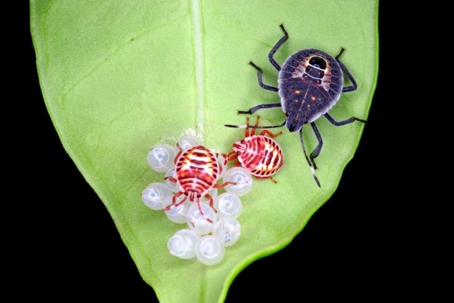
Stink bug eggs are small, barrel-shaped, and typically arranged in neat clusters. They are usually light green, yellow, or pale white when first laid, but may darken slightly as they develop. Each egg is about 1–2 millimeters in diameter and has a smooth or slightly textured surface with a distinct ring at the top. Females usually lay eggs on the undersides of leaves or other sheltered surfaces, which helps protect them from predators and environmental hazards. The eggs are laid closely together, often in groups of 20 to 30, forming a compact, organized cluster.
Stink Bug Nymphs
Stink bug nymphs represent the juvenile stage of the insect’s life cycle, bridging the gap between eggs and adults. After eggs hatch, nymphs emerge as small, wingless insects that immediately begin feeding on plant material to support their growth. They progress through five distinct instar stages, molting and increasing in size at each stage. During this period, nymphs develop the physical characteristics and strength needed for adulthood but are not yet capable of reproduction. Once they complete the final molt, they become fully developed adults ready to mate and continue the life cycle. The nymph stage is therefore critical for growth, survival, and the eventual perpetuation of the species.
Stink bug nymphs are small, wingless juveniles that look very different from adults. They are usually oval-shaped and range in color from bright red, orange, or green to brown, depending on the species and instar stage. Their bodies often have distinct markings or spines, and their legs and antennae are proportionally shorter than in adults. As nymphs grow through their five instar stages, they gradually increase in size and begin to develop adult-like features, but they do not have fully formed wings until the final molt. Nymphs are often found feeding on plant material, clustering near the eggs or on the undersides of leaves.
Adult Stink Bugs
Adult stink bugs represent the final stage of the insect’s life cycle and are essential for reproduction and population continuation. After completing the nymphal stages, adults emerge fully developed with wings and reproductive capability. They feed on plants to sustain themselves, seek mates, and reproduce, with females laying clusters of eggs to begin the next generation. Adults can live for several months, and in some species, they overwinter in protected locations, allowing them to survive unfavorable conditions and resume the reproductive cycle in spring. Without adults, the life cycle cannot continue, making this stage crucial for the persistence of stink bug populations.
Adult stink bugs are shield-shaped insects with a broad, flat body that tapers slightly at the rear. They typically measure 12–17 millimeters in length, depending on the species. Their coloration varies: common species like the brown marmorated stink bug are brown with mottled patterns, while other species may be green or have distinct markings along the edges of their body. Adults have fully developed wings folded flat over their backs, allowing them to fly, and prominent antennae that help with navigation and sensing their environment. Their characteristic shield-like shape and segmented body make them easily distinguishable from nymphs, which are smaller and wingless. Adults feed on plants, mate, and are responsible for reproducing the next generation.
Do Stink Bugs Hibernate?
Yes, stink bugs enter a form of hibernation known as overwintering to survive cold temperatures. In the fall, adult stink bugs seek out sheltered locations such as homes, attics, wall voids, or protected outdoor spaces. During this dormant period, they significantly reduce their activity, feeding very little or not at all, while conserving energy until temperatures rise in the spring. Overwintering allows stink bugs to survive harsh conditions that would otherwise be lethal and ensures they are ready to reproduce once the environment becomes favorable again.
When Do Stink Bugs Die?
Stink bugs typically die after completing their life cycle, which lasts several months depending on species and environmental conditions. Adults generally die in late fall or early winter after reproducing, although those that overwinter in sheltered areas may survive for several additional months before succumbing to cold temperatures or natural causes. Factors such as lack of food, extreme weather, predation, and disease also contribute to their mortality. Once adults die, they can no longer reproduce, which naturally limits the population until the next generation emerges from eggs in the spring.
How Fast Do Stink Bugs Reproduce?
Stink bugs typically begin mating in the spring after emerging from overwintering sites, when temperatures rise and food becomes available.
Egg-laying rate: A single female can lay multiple clusters of eggs during her lifetime, with each cluster containing 20 to 30 eggs.
Egg development: Eggs hatch relatively quickly, usually within 4 to 7 days, depending on environmental conditions such as temperature and humidity.
Nymphal development: The nymphs progress through five instar stages over 4 to 6 weeks, feeding continuously to grow into adults.
Generation frequency: Under favorable conditions, a complete generation—from egg to reproducing adult—can occur in about 6 to 8 weeks, allowing for multiple generations per year in warm climates.
Because females lay hundreds of eggs over their lifetime and development is relatively rapid, stink bug populations can expand quickly, leading to noticeable infestations within a single season.
Learn more: How To Get Rid Of Stink Bugs