
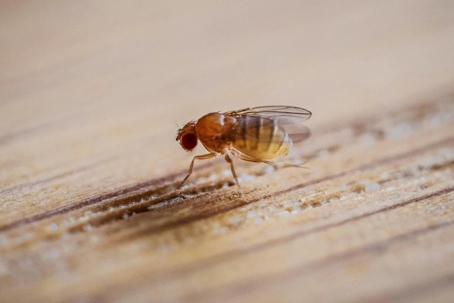
What Do Fruit Flies Look Like?
Knowing what fruit flies look like allows you to distinguish these small flies from other small insects, such as fungus gnats or drain flies, which require different control strategies. Misidentifying these pests can lead to ineffective treatment, wasted resources, and persistent infestations.
Early Detection Prevents Infestations: Recognizing fruit flies early, even in small numbers, allows you to intervene before populations explode. Fruit flies reproduce rapidly, with females laying hundreds of eggs in fermenting organic matter. Spotting the adult flies or their larvae quickly can prevent a minor issue from becoming a major infestation.
Targeted Sanitation Measures: Fruit flies are attracted to ripening or decaying fruits, vegetables, and other fermenting organic matter. Identifying them ensures you know the source of attraction so you can remove breeding sites promptly. This is crucial because even a few overlooked pieces of food can sustain a growing population.
Improved Monitoring: Recognizing the physical characteristics of fruit flies helps you set and monitor traps effectively. Knowing what to look for ensures that monitoring tools are used efficiently, and you can assess the success of control measures accurately.
Health and Food Safety Compliance: In commercial environments like kitchens, restaurants, or food processing areas, the presence of fruit flies can indicate sanitation lapses and pose contamination risks. Being able to identify them quickly supports compliance with health codes and prevents potential product spoilage or customer complaints.
Certain insecticides or biological agents are specifically effective against fruit flies. Accurate identification ensures that you choose the right product, dosage, and application method, maximizing effectiveness while minimizing unnecessary chemical exposure.
Learn more: Fruit Flies vs Drain Flies
What Size Are Fruit Flies?
Fruit flies are very small insects, typically measuring between 2 to 4 millimeters in length, which is roughly the size of a sesame seed. Their tiny size allows them to move quickly and hide in small crevices, making infestations easy to overlook in the early stages. Despite their diminutive stature, their wings span enough to allow short, rapid flights, enabling them to locate food sources and breeding sites efficiently.
How Big Are Fruit Flies?
Fruit flies are generally very small, but under optimal conditions, they can reach the upper end of their typical size range, growing up to 4–5 millimeters in length. While this may not seem significant, even a slight increase in size can make them more noticeable around food sources and breeding areas. Their small size, combined with rapid reproduction, allows populations to build quickly before being detected. Larger fruit flies may also indicate particularly favorable environmental conditions, such as abundant fermenting organic matter and warm temperatures, which accelerate growth and development from egg to adult. Understanding the potential size range helps in distinguishing fruit flies from other small insects and in implementing timely control measures.
How Small Are Fruit Flies?
Fruit flies can be remarkably tiny, sometimes measuring as little as 2 millimeters in length, which is about the size of a pinhead. At this size, they are easily overlooked, especially when resting on surfaces or hovering near fruit, vegetables, or other organic matter. Their minute stature allows them to access even the smallest cracks, drains, or crevices where they can feed and lay eggs, making early detection challenging. Recognizing their potential to be so small is crucial for effective monitoring and control, as infestations can develop unnoticed until the population has grown substantially.
Are Fruit Flies Visible?
Yes, fruit flies are visible to the naked eye, though their small size—typically 2 to 4 millimeters—means they can be easy to overlook, especially in cluttered or busy environments. Their tan or light brown bodies and bright red eyes make them distinguishable once noticed, and their quick, erratic flight patterns often draw attention. While individual flies are tiny, infestations are usually easier to spot because of the sheer number of adults hovering around food sources, fermenting organic matter, or trash areas. Visibility can also be enhanced using traps or by observing their preferred breeding and feeding sites.
What Color Are Fruit Flies?
The most common color of fruit flies is a tan or light brown hue. This coloration helps them blend in with decaying fruit, vegetables, and other organic materials where they feed and lay eggs.
Red Eyes: One of the most distinctive features of fruit flies is their bright red eyes, which contrast sharply with their lighter body color. This is often the easiest characteristic to spot when identifying them.
Darker Brown or Black Markings: Some species of fruit flies may have slightly darker brown or black markings on their abdomen or thorax, although these are subtle and not present on all individuals.
Clear or Lightly Tinted Wings: While not a body color, the wings are typically clear or slightly tinted and are often visible in flight. Their transparency can make them harder to see when resting.
In rare cases, environmental factors or genetic variation may cause slight differences in overall body shade, but the classic combination of a light brown body with red eyes remains the primary identifier.
What Shape Are Fruit Flies?
Fruit flies have a compact, oval-shaped body that tapers slightly at the rear. This streamlined shape allows them to maneuver easily in tight spaces and fly quickly between food sources.
Rounded Head: Their head is small and rounded, featuring prominent red compound eyes that occupy a significant portion of the head’s surface. The rounded shape contributes to their wide field of vision, aiding in navigation and locating food.
Segmented Thorax and Abdomen: The thorax is slightly more robust than the abdomen and is where the wings and legs attach. The abdomen is narrower and segmented, giving the fly flexibility for movement and reproduction.
Clear, Elongated Wings: Fruit fly wings are long and narrow relative to the body, with a slight curve at the tips. The wing shape enables quick, agile flight, allowing the fly to dart rapidly from surface to surface.
Short, Thin Legs: Their legs are thin and relatively short, with small claws at the ends for gripping surfaces. Despite their delicate appearance, these legs provide stability and mobility across a variety of substrates.
What Fruit Flies Look Like
Eyes: Fruit flies have prominent, bright red compound eyes that are large relative to their heads. These eyes give them excellent vision for detecting movement and locating food sources.
Wings: Their wings are transparent, delicate, and slightly iridescent, with subtle veining visible under close inspection. They flap rapidly, allowing the flies to hover and make quick, erratic movements.
Antennae: Fruit flies possess short, feathery antennae on their heads, which are highly sensitive to odors and help them detect fermenting fruits and other organic matter.
Legs and Feet: Their legs are thin and spindly, ending in tiny claws that allow them to cling to smooth or uneven surfaces, including fruits, countertops, and drains.
Behavioral Appearance: Fruit flies are often seen hovering near or landing on food, especially ripened or decaying produce, sugary liquids, and moist organic matter. Their quick, darting flight and tendency to cluster in small groups are characteristic behaviors that make them noticeable despite their small size.
Mouthparts: Fruit flies have small, sponge-like mouthparts adapted for feeding on liquids, including fermenting juices, overripe fruit, and sugary residues. This gives them a slightly “tapping” behavior when they land on surfaces to feed.
These visual and behavioral features together make fruit flies identifiable even without considering their size, shape, or color.
What Do Fruit Fly Larvae Look Like?
Fruit fly larvae, often referred to as "maggots," have distinct features that set them apart from the adult fruit flies. These larval stages are the second phase in the fruit fly's life cycle, following the hatching of their eggs. Here's a description of what fruit fly larvae look like:
- Size: Fruit fly larvae are small and typically range from 2 to 4 millimeters in length. They are elongated and cylindrical in shape.
- Color: When they first hatch, fruit fly larvae are almost transparent, appearing as tiny, white, or pale yellow worms. However, as they feed and grow, they may take on a slightly translucent or cream-colored appearance.
- Body Segmentation: The larvae have distinct body segments. Their body is divided into three main parts: the head, thorax, and abdomen. The head has two small, dark-colored mouthhooks that they use for feeding.
- Movement: Fruit fly larvae have a characteristic wriggling or crawling motion. They move in a characteristic "S" shape, which helps them navigate through the decaying matter on which they feed.
- Antennae and Legs: Fruit fly larvae do not have developed antennae or legs, which distinguishes them from the adult flies. They rely on their mouthhooks for feeding and their body's undulating movements for locomotion.
- Size Increase: As they feed and grow, fruit fly larvae can increase in size significantly over a short period, depending on the availability of food.
Fruit fly larvae are often found in and around decaying fruits, vegetables, and other organic materials, where they feed on the fermenting matter. They play a crucial role in the decomposition process by breaking down organic material into simpler compounds. After a period of feeding and growth, they undergo pupation to transform into the next stage of their life cycle, which eventually leads to the emergence of adult fruit flies.
What Do Fruit Fly Eggs Look Like?
Fruit fly eggs are tiny, oval-shaped structures that are typically about 0.5 millimeters in length. They are extremely small and can be difficult to see with the naked eye, but under magnification, you can observe their characteristic features:
- Transparency: Fruit fly eggs are translucent or semi-transparent, which means they have a see-through appearance. This transparency helps them blend in with the substrate on which they are laid.
- Size: As mentioned, they are very small, measuring about half a millimeter. This makes them much smaller than a grain of rice and barely visible without the aid of a magnifying glass or microscope.
- Shape: Fruit fly eggs have an elongated oval shape. They are slightly curved and taper at both ends, giving them a subtle, symmetrical appearance.
- Color: When first laid, fruit fly eggs are typically whitish or pale yellow. As they develop, they may darken slightly.
- Location: Fruit flies typically deposit their eggs near or on decaying or fermenting organic materials, especially overripe fruits, vegetables, and other food sources. You'll often find clusters of eggs in these areas.
- Attachment: Fruit fly eggs are adhesive, allowing them to stick to the surface where they are laid. This adhesive quality helps secure them to the substrate and prevents them from easily being dislodged.
Fruit fly eggs are the first stage in the life cycle of these insects. After a short period of incubation, they hatch into tiny larvae, commonly referred to as "maggots," which then feed on the decaying organic matter before pupating and eventually emerging as adult fruit flies. Their rapid reproductive cycle and attraction to organic materials make them a common pest in homes and food storage areas.
Do Fruit Flies Have Nests?
Fruit flies do not build nests in the same way that social insects like ants or bees do. Instead, they lay their eggs in or near decaying organic matter, and that's where the developing larvae (maggots) feed and grow. So, you won't find constructed nests in the traditional sense. However, you can observe the following characteristics associated with the breeding sites of fruit flies:
- Cluster of Eggs: Fruit flies lay their eggs in clusters, often on or near overripe fruits, vegetables, or other decaying organic materials. These clusters may appear as tiny, whitish or pale yellow ovals, tightly grouped together.
- Decaying Matter: Fruit flies prefer to lay their eggs on or near organic matter that is fermenting or decomposing. The presence of numerous eggs in or around such materials indicates a potential breeding site.
- Moisture: Fruit fly larvae require moisture to thrive, so breeding sites are often associated with moist environments. You might notice small pools of liquid or condensation around the breeding area.
- Fruit Flies: Of course, the presence of adult fruit flies in the vicinity is a strong indicator of a breeding site. Adult fruit flies are attracted to the same decaying matter where they lay their eggs.
- Odor: The fermentation and decomposition of organic materials produce distinctive odors, which can be strong and unpleasant. The presence of a foul odor may lead you to a breeding site.
- Visible Larvae: If the infestation is advanced, you may actually see the tiny fruit fly larvae (maggots) wriggling in and around the decaying matter. They feed on the material and are often clustered together.
Fruit flies reproduce quickly, and identifying and eliminating their breeding sites is essential for effective pest control. Cleaning up and properly disposing of overripe fruits, vegetables, and other organic waste, as well as maintaining cleanliness in the kitchen and storage areas, can help prevent and manage fruit fly infestations.
Last Updated: 12/17/2025