Flesh Flies
Are Flesh Flies Harmful?
Flesh flies (Sarcophagidae) can be harmful in several ways, primarily due to their association with decaying organic matter and their potential to spread diseases. Below are some of the concerns related to their presence:
Disease Transmission
Flesh flies frequently come into contact with decomposing animal remains, feces, and garbage, making them potential vectors for bacteria and pathogens. They can contaminate surfaces, food, and wounds, spreading harmful microorganisms that cause:
- Foodborne Illnesses: Bacteria such as Salmonella and E. coli can be transmitted, leading to symptoms like diarrhea, vomiting, and fever.
- Dysentery: Flesh flies can carry pathogens that cause dysentery, a severe gastrointestinal disease.
- Other Infections: They may spread bacteria leading to skin infections, conjunctivitis, or respiratory issues.
Myiasis (Tissue Infestation)
Some species of flesh flies are capable of causing myiasis, a condition where fly larvae infest living or dead tissue. This can occur in:
- Humans: Larvae may enter open wounds, skin lesions, or even body cavities, leading to painful infestations that require medical intervention.
- Livestock & Pets: Flesh flies can infest wounds, sores, or neglected areas on animals, leading to significant health issues and economic losses in the agricultural industry.
Pest and Nuisance Issues
- Indoor Infestations: If a dead rodent or animal is inside walls, attics, or crawl spaces, flesh flies may appear in large numbers when their larvae mature into adult flies.
- Unpleasant Presence: Their attraction to decaying material and feces makes them unsanitary pests around homes, businesses, restaurants, and farms.
- Rapid Reproduction: Because they deposit live maggots instead of eggs, infestations can occur quickly, making control difficult if sanitation measures are not in place.
Economic and Veterinary Impact
- Agricultural Concerns: Flesh flies can parasitize livestock, reducing productivity and requiring veterinary treatments.
- Food Industry Risks: In food production or processing facilities, their presence can lead to contamination, product recalls, and regulatory violations.
Learn more: Do Flesh Flies Bite?
Flesh Fly Removal
Flesh flies (family Sarcophagidae) are more than just a nuisance; these flies pose several significant health, sanitation, and operational risks that make controlling or eliminating them crucial. Here’s why their removal is important:
Disease Transmission
Flesh flies are known carriers of numerous pathogens because of their feeding and breeding habits. They feed on decaying organic matter, including dead animals, feces, and rotting food. This behavior allows them to pick up and transfer bacteria, viruses, and parasites. Notable pathogens associated with flesh flies include:
- Salmonella spp. – causing gastrointestinal infections.
- E. coli – including harmful strains that lead to diarrhea and more severe illness.
- Shigella spp. – responsible for bacterial dysentery.
- Staphylococcus and Streptococcus – which can cause skin infections or systemic illness.
Because flesh flies often land on human food, utensils, or surfaces, they are vectors for contamination, leading to potential outbreaks, especially in food-handling environments.
Rapid Reproduction and Infestation Potential
Flesh flies reproduce quickly. Unlike house flies, some flesh fly species are larviparous, meaning they deposit live larvae rather than eggs. These larvae can begin feeding immediately on organic matter, accelerating decomposition and infestation. In a short period, a small population can multiply into a serious problem that is difficult to control.
Attraction to Dead or Decaying Matter
Flesh flies are primarily attracted to carcasses, open wounds, or decaying organic material. This creates specific risks:
- Pets and livestock: Flesh flies can infest wounds in animals, leading to myiasis, a condition where fly larvae feed on living or necrotic tissue, causing severe pain, infection, and tissue damage.
- Sanitation concerns: Their presence indicates unclean conditions or poor waste management. In commercial environments such as restaurants, hospitals, or food processing facilities, this is unacceptable and can lead to regulatory fines or shutdowns.
Secondary Infestation Risks
Even if flesh flies themselves do not bite humans, their larvae can infest wounds or necrotic tissue. Additionally, they can indirectly attract other pests that feed on decomposing material, exacerbating a general pest problem.
Operational and Reputational Impact
For businesses and homeowners alike, a visible flesh fly problem is damaging:
- Restaurants, hospitals, and food industries may face serious reputation and compliance risks if customers or regulators observe flies.
- For residential properties, persistent flies suggest hygiene or structural issues that can be costly to resolve.
- In agriculture, livestock welfare is directly affected, impacting productivity and increasing veterinary costs.
Getting rid of flesh flies is not just a matter of comfort; it’s essential for preventing disease, avoiding infestations, protecting animals, and maintaining hygiene and regulatory compliance. Because of their rapid reproductive cycle and attraction to decaying organic matter, addressing them early and comprehensively—through sanitation, exclusion, and targeted pest control—is critical to minimizing their health and economic risks.
Learn more: How To Get Rid Of Flesh Flies
Flesh Fly Control
Hiring our professional pest control for flesh flies is the most effective and reliable way to eliminate these flies and prevent recurring infestations. Flesh flies are more than just a nuisance — they are associated with decaying organic material, carrion, garbage, and even animal remains, which means they can spread harmful bacteria and pathogens wherever they land. Here are the main reasons professional pest control is the best solution for flesh flies:
- Accurate Source Identification: Flesh fly infestations often indicate an underlying problem, such as a dead animal, decaying organic waste, or an unnoticed breeding site in walls, crawlspaces, or attics. Our professionals use inspection tools and experience to pinpoint these sources, which homeowners often miss. Simply killing the adult flies won’t solve the problem if breeding sites remain.
- Comprehensive Treatment Strategy: Our pest control experts use an integrated approach that includes sanitation, exclusion, and targeted treatments. We apply professional-grade insecticides and fly baits in strategic locations where flesh flies breed and rest. This ensures full elimination rather than temporary relief from adult flies.
- Prevention of Health Risks: Because flesh flies can transmit bacteria like E. coli and Salmonella after feeding on decaying material, our professional treatments minimize the risk of contamination in your home or business. Our technicians also provide guidance on proper sanitation and waste management to prevent future outbreaks.
- Safe and Regulated Use of Products: DIY insecticide sprays rarely reach breeding sites and may pose health risks if misused. Our licensed professionals use EPA-approved materials safely, ensuring effective results without endangering people, pets, or property.
- Long-Term Prevention Plans: We don’t just eliminate the current infestation — we help ensure it doesn’t return. Through routine monitoring, sealing of potential entry points, and environmental recommendations, we create lasting protection against flies and other pests.
- Fast, Reliable, and Professional Results: Flesh fly infestations can escalate quickly, especially in warm weather. Our professionals have the training, tools, and response time to resolve the issue quickly and efficiently, protecting your reputation and health — especially important for businesses such as restaurants, markets, or medical facilities.
Our professional pest control delivers a complete, safe, and preventive solution to flesh fly problems — far more effective than any DIY measures.
Flesh Fly Exterminators
When dealing specifically with flesh flies, hiring our local exterminators provides distinct advantages over a national pest control company. The differences go beyond convenience:
Local Expertise and Knowledge of Regional Pests
Flesh fly species vary regionally in behavior, breeding sites, and seasonal activity. Our local exterminators:
- Understand which Sarcophagidae species are prevalent in the area.
- Knows their specific breeding habits—e.g., whether they favor animal carcasses, waste piles, or open wounds in livestock.
- Can anticipate seasonal spikes in fly populations and proactively prevent infestations.
National companies will often rely on standardized protocols that aren’t tailored to local environmental conditions, which can reduce effectiveness.
Familiarity with Local Laws and Regulations
Flesh fly control involves methods often regulated at the local and/or state level, particularly when using chemical treatments near livestock or in food-handling areas. Our local exterminators:
- Are typically fully compliant with local pesticide laws.
- Can navigate municipal health codes efficiently.
- Reduce your risk of fines or regulatory issues.
National companies may have broader policies that don’t account for local regulatory nuances, leading to slower approvals or sometimes even missed legal requirements.
Customized and Targeted Treatment Plans
Flesh flies require highly specific interventions:
- Sanitation and source control (removing carcasses, properly storing waste, cleaning drains).
- Larval treatments for any infestations in organic matter.
- Adult fly control using baits, traps, or targeted residual sprays.
Our local exterminators can inspect your property thoroughly, identify precise fly breeding sites, and design a plan that specifically addresses flesh fly biology. National companies will often use generalized fly control programs that focus on house flies or gnats and overlook the unique needs of flesh flies.
Faster Response Times
Flesh flies reproduce rapidly and can escalate an infestation in just a few days. Our local exterminators:
- Respond quickly to urgent calls.
- Monitor progress with ongoing protective services visits.
- Adjust treatments immediately based on results.
National companies typically rely on centralized scheduling and often have longer response times, delaying crucial interventions that prevent further infestation.
Accountability and Personal Service
Our local professionals rely heavily on our reputation within the community, so we are highly motivated to ensure successful results.
National chains may offer guarantees, but follow-up is often bureaucratic and less personalized, which can hinder timely problem resolution.
For flesh fly infestations, our local exterminators bring precise knowledge, rapid intervention, tailored treatments, and strong accountability. Flesh flies are not a generic “fly problem”—they require attention to breeding sources, larval habitats, and local environmental conditions. A national company’s standardized protocols often cannot match the speed and specificity that our local experts provide.
Flesh Fly Solutions
Our exterminators use Integrated Pest Management (IPM) to control flesh flies because these insects are attracted to decaying organic matter, garbage, and animal carcasses, and can spread bacteria, contaminate food, and create significant nuisance issues. IPM begins with a thorough inspection to identify breeding and feeding sites, such as trash bins, compost piles, pet waste areas, and areas with poor sanitation. Management strategies focus on habitat modification, including proper waste management, removing decaying organic matter, improving sanitation, and securing food sources to make environments less attractive to the flies. Targeted interventions, such as traps or localized insecticide applications, are used only when necessary to minimize chemical exposure. Ongoing monitoring allows our exterminators to track fly activity, evaluate the effectiveness of control measures, and prevent reinfestation. By combining inspection, habitat management, selective control, and monitoring, IPM provides a long-term, environmentally responsible, and effective approach to managing flesh fly populations.
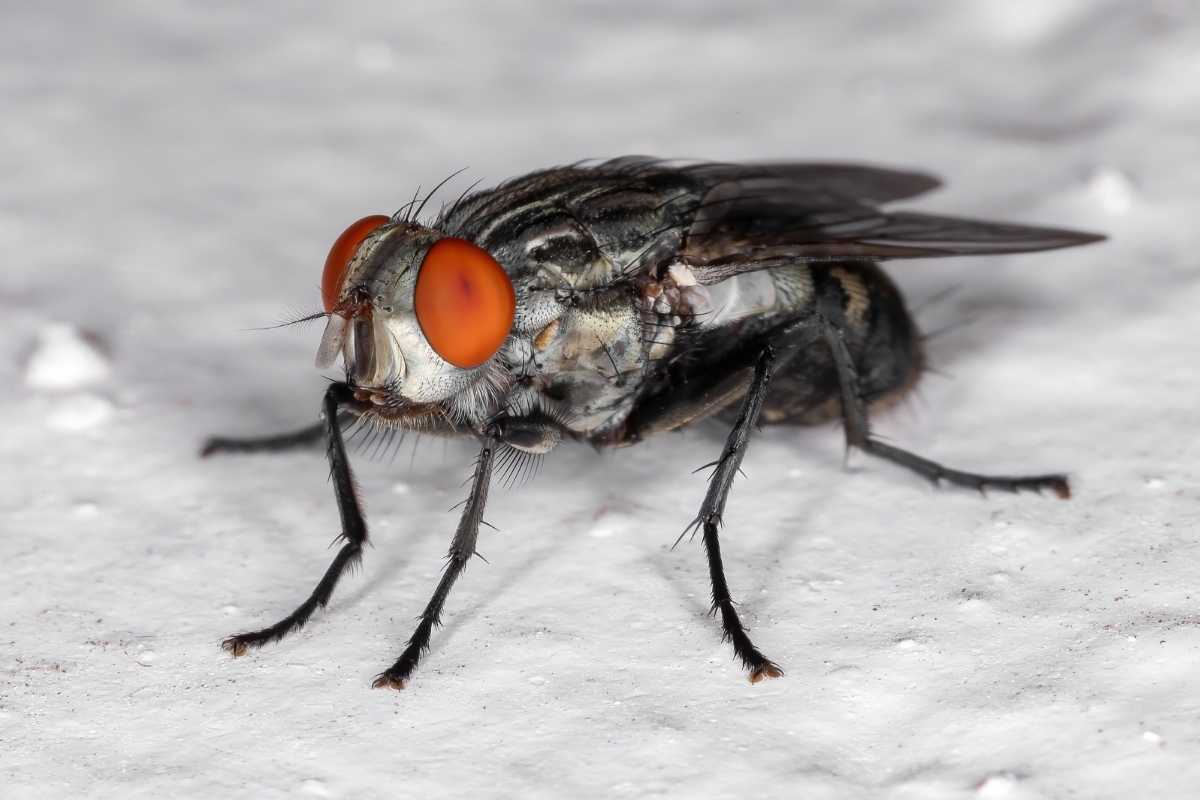
What Do Flesh Flies Look Like?
Flesh flies (Sarcophagidae) have a distinctive appearance that makes them relatively easy to identify. Here are some of their physical characteristics:
Size & Shape
- Medium to large-sized flies, typically 10–14 mm (0.4–0.6 inches) long
- Stout, bristly bodies with a slightly humped thorax
Color & Markings
- Grayish body with three prominent black stripes on the thorax
- Checkered or spotted abdomen, often gray and black
- Red eyes, sometimes large and prominent
- Dark legs, usually black or dark brown
Wings & Flight
- Transparent wings with visible veins
- Strong, fast flyers, often seen hovering around decaying matter
Unique Features
- Unlike many other flies, flesh flies are larviparous, meaning they deposit live maggots instead of laying eggs
- Some species have a reddish or orange-brown tip on the abdomen
Where Are Flesh Flies Found?
You are most likely to encounter flesh flies in areas where decaying organic matter is present, as they are attracted to carrion, feces, and rotting food. Below are the most common locations where flesh flies tend to appear:
Outdoors
- Near Dead Animals: Flesh flies are strongly attracted to carcasses of rodents, birds, and other animals. If there is a dead animal nearby, you may see an influx of these flies.
- Garbage & Dumpsters: Open or overflowing trash bins with decomposing food scraps can attract flesh flies.
- Compost Piles: If compost is not properly managed, it can become a breeding ground.
- Animal Feces: Pet waste, manure, and other animal droppings can serve as a food source for larvae.
- Slaughterhouses & Farms: Locations with livestock, especially those with open wounds or decaying organic waste, often experience infestations.
Indoors
- Around Dead Rodents or Pests: If a rodent or small animal has died inside a wall, attic, or crawl space, flesh flies may appear as larvae feed on the carcass and mature into adults.
- Trash Bins & Food Storage Areas: Poorly sealed garbage cans or rotting organic matter inside the home can attract them.
- Restrooms & Sewage Areas: Since they are drawn to decaying matter, neglected restrooms or plumbing issues can become breeding sites.
- Hospitals & Veterinary Clinics: In rare cases, flesh flies can infest open wounds or medical waste.
What Do Flesh Flies Eat?
Flesh flies (Sarcophagidae) have a diet primarily based on decaying organic matter. Their feeding habits vary depending on their life stage:
Adult Flesh Flies
- Adult flesh flies primarily feed on liquefied organic materials, including:
- Nectar and plant juices – They sometimes feed on flower nectar or sugary plant excretions.
- Rotting fruit and vegetables – Decomposing organic matter can attract them.
- Animal excretions (feces) – They often feed on and lay larvae in dung or waste.
- Liquids from decaying meat and carrion – They lap up juices from decomposing carcasses.
Flesh Fly Larvae (Maggots)
- Flesh fly larvae are more carnivorous and feed on:
- Decaying animal carcasses – They thrive in dead rodents, birds, and other animals.
- Open wounds and necrotic tissue – Some species can infest live animals, consuming dead or infected tissue.
- Garbage and decomposing organic waste – If conditions are favorable, maggots may develop in rotting food or trash.
- Parasitic hosts – Some species lay their larvae inside the bodies of live insects, amphibians, or even mammals, where they develop by consuming the host’s tissue.
Since flesh flies are scavengers, they play a role in breaking down decaying matter, but they can also be problematic in homes, businesses, and agricultural settings.
Flesh Fly Life Cycle
The life cycle of flesh flies (Sarcophagidae) consists of four main stages: egg (skipped in most species), larva, pupa, and adult. The entire cycle can take anywhere from 8 to 21 days, depending on environmental conditions such as temperature and food availability.
1. Egg Stage (Usually Skipped)
- Unlike most other flies, flesh flies are larviparous, meaning they do not lay eggs. Instead, they deposit live larvae (maggots) directly onto a food source (e.g., carrion, feces, or decaying matter).
- This adaptation gives their offspring an advantage, as they can begin feeding immediately, increasing survival rates.
2. Larval Stage (Maggots)
- Upon being deposited, the maggots immediately start feeding on the organic matter.
- There are three instar stages, during which the maggots grow and molt.
- This stage typically lasts 4 to 5 days, depending on temperature and food availability.
- Once fully grown, the larvae leave the food source and burrow into soil, debris, or a secluded area to pupate.
3. Pupal Stage
- The maggots form a dark, hardened puparium (similar to a cocoon).
- Inside, the transformation into an adult fly occurs over 3 to 10 days, depending on conditions.
- The fly emerges as an adult, ready to mate and restart the cycle.
4. Adult Stage
- Freshly emerged adults begin mating within a few days.
- Females seek out suitable sites (carrion, feces, wounds, or decomposing material) to deposit their larvae.
- Adults live for several weeks, during which females can deposit multiple batches of larvae.
- A single female can produce hundreds of larvae in her lifetime.
Since flesh flies reproduce quickly, they can become a nuisance if conditions are favorable.
Hear From Our Happy Customers
-
"Professional & Considerate"
I’m pleased with Miche services. Jarvis came today. Professional and considerate. Thank you!
- Judy B. -
"Wonderful Service"
Wonderful service. Jarvis is great. Took care of everything I needed. Thank you!
- Henry P. -
"Exceeds Expectations"
I can’t say enough positive things about this company... The tech that came out, Jarvis went above and beyond my expectations. Thank you guys, I will continue using your services.
- Jake M. -
"Fantastic & Patient"
Jarvis was fantastic and patient. He answered my questions with an in-depth explanation and addressed all of my areas of concern. Would love for him to be my assigned tech going forward. Well done!
- Yonnette M. -
"Very Knowledgeable"
The tech that arrived was courteous, professional, and very knowledgeable. He was Great.
- Uerial I. -
"Great Communication"
Tech was on time, communication was great, and he accommodated my needs.
- Alonzo W.