
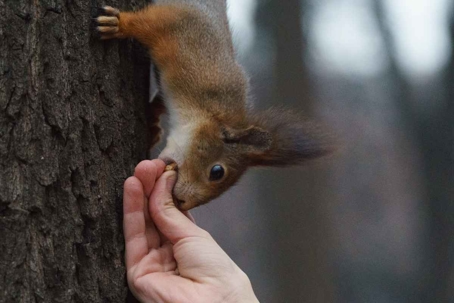
Do Squirrels Bite?
Squirrels are generally not aggressive toward humans, but these rodents can and do bite in certain situations. Understanding these situations is key, especially if you handle or encounter squirrels:
Self-Defense or Fear
Squirrels are wild animals and will bite if they feel threatened. This is the most common reason for bites.
These situations include trying to pick up or corner a squirrel, attempting to touch or feed a squirrel that is frightened, and approaching a squirrel suddenly or making loud noises near it.
Protecting Their Young
Mother squirrels are particularly defensive when their nests or babies are threatened.
Bites can occur if a person gets too close to a tree cavity or nest containing young squirrels.
Food-Related Aggression
Squirrels may bite if they perceive a hand as a food source or if they are being fed directly by people.
Bites can happen when hand-feeding wild squirrels (they may mistake fingers for nuts), and when fighting over food with pets or humans.
Territorial Aggression
Though rare, squirrels may bite other animals or humans if they feel their territory is being invaded.
More common with urban squirrels, which can be more habituated to human presence and more assertive in defending areas with food.
Injury or Illness
A sick or injured squirrel may bite if approached because it is stressed or unable to escape.
Wildlife diseases like rabies are rare in squirrels, but they can carry other pathogens.
Wild squirrels are unpredictable; avoid direct contact. Bites often occur when people try to capture, corner, or feed them. Pets, especially cats or dogs, may provoke bites if they chase or corner a squirrel.
Squirrel Bites
Squirrel bites, while relatively uncommon, carry several specific risks. Understanding these risks is important for proper wound care and health precautions:
Infection
Bacterial infections are the most common risk from squirrel bites. Wild squirrels carry bacteria in their mouths that can infect humans. Potential bacteria include Staphylococcus and Streptococcus species, Pasteurella multocida (commonly associated with mammal bites), and Bartonella species (rare, can cause “cat scratch disease”-type symptoms)
Signs of infection: redness, swelling, warmth, pus, fever, or increasing pain around the bite site.
Rabies (Very Rare)
Squirrels are extremely unlikely to carry rabies. There are very few documented cases worldwide.
Rabies risk is minimal, but medical professionals may still assess the situation, especially if the squirrel was behaving unusually (aggressive, disoriented).
Tetanus
Any puncture wound from an animal can potentially introduce Clostridium tetani.
People should ensure their tetanus vaccination is up to date.
Viral or Parasitic Transmission
Squirrel bites can transmit other zoonotic agents, although this is rare. These may include Squirrel pox virus (very rare in humans), among other viruses.
Allergic Reaction
Some individuals may develop a local or systemic allergic reaction to proteins in the squirrel’s saliva.
Signs: excessive swelling, redness, itching, or in rare cases, hives or respiratory issues.
Delayed Complications
Scarring: Bites may leave puncture scars if deep.
Joint or tendon involvement: Bites to hands or fingers may damage tendons or joints, increasing the risk of infection or impaired movement.
What Do Squirrel Bites Look Like?
Squirrel bites have some distinctive characteristics, although they can vary depending on the size of the squirrel, the location of the bite, and the circumstances:
Puncture Wounds
Squirrels have sharp, chisel-like front incisors that leave paired puncture marks.
Usually, you will see two small, closely spaced holes where the upper and lower teeth penetrated the skin.
Punctures can be deep relative to the size of the bite, even if the surface wound looks small.
Tearing or Laceration
If the squirrel bites and shakes its head or the skin stretches, the wound may have ragged edges rather than clean cuts.
Lacerations are more likely if the bite occurs on a hand, finger, or wrist, where the skin is more flexible.
Swelling and Redness
The bite site often becomes red, swollen, and tender within hours.
Some people develop a bruise around the puncture site due to tissue trauma.
Bleeding
Squirrel bites may bleed lightly to moderately; severe bleeding is uncommon unless a major vessel is struck.
Puncture wounds can sometimes “seal” over quickly, making the injury appear minor while the puncture is deeper.
Secondary Signs of Infection
Within 24–48 hours, infected bites may show:
Pus or fluid oozing
Increasing warmth and redness
Streaking up the limb (possible lymphangitis)
Pain beyond the bite site
Location Patterns
Hands, fingers, or arms are the most common bite sites, as people often try to touch or feed squirrels.
Bites on legs or feet are less common but can occur if a squirrel is cornered on the ground.
A classic squirrel bite is two small, round punctures side by side, possibly surrounded by redness and mild swelling. If the skin is torn, it may appear as a small laceration radiating from the punctures.
What To Do About Squirrel Bites
If you get bitten by a squirrel, prompt and thorough care is important to prevent infection and other complications, even though serious diseases from squirrels are rare. Here’s what to do if you get bitten by a squirrel:
Immediate Wound Care
Wash the bite thoroughly with soap and clean running water for at least 5–10 minutes.
Remove any dirt or debris from the wound.
Apply an antiseptic such as iodine, hydrogen peroxide, or alcohol to disinfect the area.
Do not squeeze the wound excessively, as this can damage tissue and worsen infection risk.
Stop the Bleeding
If the bite is bleeding, apply gentle pressure with a clean cloth or sterile gauze until it stops.
Elevate the affected limb if possible to reduce bleeding and swelling.
Cover the Wound
Use a sterile bandage or dressing to keep the bite clean.
Change the dressing at least once daily or whenever it becomes wet or dirty.
Medical Evaluation
Seek professional medical care if any of the following apply:
The bite is deep, bleeding heavily, or on the hand, face, or near a joint.
You notice redness, swelling, pus, warmth, or streaking up the limb.
Your tetanus vaccination is not up to date (within the last 10 years, or 5 years for high-risk bites).
You are immunocompromised or have underlying health issues.
Monitor for Infection
Watch for: increasing redness, swelling, pus, pain, fever, or lymph node swelling near the bite.
Seek medical attention immediately if symptoms worsen.
Avoid Risky Behavior in the Future
Do not handle wild squirrels.
Avoid hand-feeding, and keep pets away from squirrels to prevent bites.