
What Do Opossums Look Like?
Opossums, also known as possums, are frequently confused with rats, raccoons, skunks, or even small dogs. Misidentifying an animal can lead to using the wrong control method, setting ineffective traps, or applying exclusion strategies that don’t address the real issue. Accurate visual recognition helps ensure the response matches the species involved, saving time, money, and frustration.
Different animals pose different risks: Opossums have a very different risk profile than rodents or raccoons. For example, they are unlikely to carry rabies compared to many mammals, but they can harbor parasites like fleas and ticks. Knowing what an opossum looks like allows you to assess real health concerns instead of assuming worst-case scenarios associated with other wildlife.
Behavioral understanding depends on recognition: Opossums have unique behaviors—most notably “playing dead,” moving slowly, and showing their teeth defensively without attacking. If someone doesn’t recognize an opossum, these behaviors may be misinterpreted as aggression or illness, leading to unnecessary panic or unsafe handling attempts.
Legal and ethical compliance matters: Wildlife laws often regulate how certain animals can be handled, relocated, or removed. Opossums are typically protected as native wildlife, and improper treatment can result in legal penalties. Visual identification helps ensure actions stay within legal and ethical boundaries.
Property damage is addressed more effectively: The type of damage opossums cause—overturned trash cans, garden foraging, denning under decks—differs from damage caused by burrowing rodents or attic-dwelling raccoons. Recognizing the animal by appearance helps target the correct entry points and prevention methods instead of applying generic or ineffective solutions.
Public safety and calm decision-making improve: When people know what an opossum looks like, they are less likely to react with fear or attempt dangerous interactions. Calm recognition promotes safer distancing, appropriate responses, and better communication when professionals are involved.
Opossums play a beneficial role in ecosystems by consuming insects, carrion, and even ticks. Misidentification often leads to animals being killed or displaced without cause. Knowing what an opossum looks like supports informed decisions that balance safety with ecological responsibility.
What Size Are Opossums?
Adult opossums typically measure 24 to 40 inches long from nose to tail tip. About one-third to one-half of that length is the tail, which is long, hairless, and used for balance and gripping—making the body itself appear shorter than the total measurement suggests:
Body length (excluding tail): The main body of an opossum generally measures 13 to 22 inches. This puts them roughly in the size range of a large house cat, though their low posture and stocky build often make them look smaller at a glance.
Weight range: Most adult opossums weigh between 4 and 15 pounds. Males are usually heavier than females, and individuals in urban or suburban environments often weigh more due to easy access to food.
Height and posture: When standing, opossums are typically 10 to 14 inches tall at the shoulder. They carry their bodies low to the ground with short legs, which contributes to frequent misidentification as oversized rats.
Juvenile size differences: Young opossums can be as small as 3–8 inches long when first visible outside the pouch. These juveniles are commonly mistaken for rats or mice because their proportions are not yet fully developed.
Seasonal and regional variation: Opossums in colder climates or food-rich areas often grow larger, while those in warmer or resource-limited regions tend to be smaller. Body condition also fluctuates seasonally, with opossums often heavier in fall than spring.
Understanding the true size of opossums helps distinguish them from rodents, which rarely exceed 2 pounds, and from raccoons, which commonly exceed 15–20 pounds. This clarity is critical for selecting appropriate exclusion, trapping, and prevention strategies.
What Color Are Opossums?
Opossums are known for their distinctive coloration, which can be described as follows:
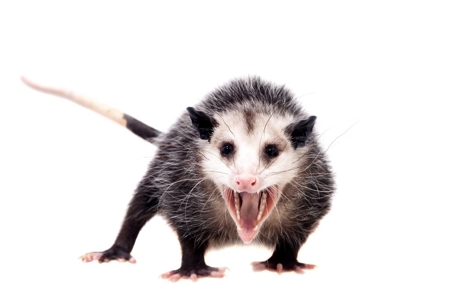
- Fur Color: The fur of opossums is typically grayish-white to light gray. It has a somewhat coarse texture and is often described as "salt-and-pepper" or "grizzled" in appearance. This mottled coloration helps them blend into a variety of environments, from forests to urban areas.
- Guard Hairs: Opossums have a mix of white and black guard hairs in their fur. These guard hairs contribute to their grizzled appearance. The arrangement of these hairs varies among individuals, giving each opossum a somewhat unique pattern.
- Face and Ears: Their faces are covered in the same grayish-white fur, and their ears are hairless and pinkish in color. The pink or flesh-colored nose is another distinctive feature of their facial appearance.
- Tail: Opossums have a long, prehensile tail that is also covered in grayish-white fur. The tail can sometimes appear darker towards the tip.
- Marsupial Pouch: In female opossums, the marsupial pouch is located on the abdomen and is hairless. It is generally a lighter color compared to the fur.
- Variation: While the described coloration is typical for opossums, there can be some variation among individual animals and species. For example, some opossums may have slightly different shades of gray or variations in the intensity of the mottling.
Opossums' coloration is adapted for camouflage in their natural habitats, and it helps them blend into a variety of environments, especially at night when they are most active. Their unique appearance makes them easily recognizable in the wild.
What Shape Are Opossums?
Opossums have a long, narrow body carried close to the ground. Their torso is cylindrical rather than rounded, giving them a stretched-out appearance when walking or standing. This low profile is one of the main reasons they’re often mistaken for oversized rats.
Head shape: pointed and wedge-like: The head is long and triangular, tapering to a narrow, pink nose. Compared to raccoons or cats, an opossum’s face looks more angular, with a pronounced snout designed for foraging rather than biting or tearing.
Legs and posture: short legs, crouched stance: Opossums have short, outward-angled legs that keep their belly relatively close to the ground. Their posture is slightly hunched, contributing to a slow, waddling gait instead of quick, agile movement.
Tail shape: long, thin, and cylindrical: The tail is nearly hairless, rope-like, and prehensile, extending straight back rather than fluffing out. This tail shape is a major visual identifier and adds to the animal’s overall elongated silhouette.
Back and shoulder profile: sloped and uneven: The shoulders often appear higher than the hips, creating a sloped back line. This makes the opossum look heavier in the front and lighter toward the rear, especially when viewed from the side.
Fur distribution affects perceived shape: Opossums have coarse fur that sticks outward unevenly, which can make them look bulkier than they actually are. When wet, thin, or malnourished, their true narrow body shape becomes much more obvious.
The combination of a long body, pointed face, short legs, and hairless tail clearly separates opossums from rodents (shorter bodies), raccoons (rounder, heavier builds), and skunks (thick tails and compact shapes). Recognizing this shape helps ensure accurate identification and appropriate response.
What Opossums Look Like
Distinct facial features: Opossums have a very expressive face with a pronounced nose pad, visible nostrils, and small, beady eyes set widely apart. Their facial structure gives them a sharp, alert appearance that often looks more intimidating than their actual behavior.
Unusual teeth and mouth: They possess 50 teeth, which is more than any other land mammal in North America. The teeth are sharply pointed and very visible when the mouth is open, especially during defensive displays. This often leads people to assume aggression, even though it is typically a bluff response.
Highly dexterous feet: Opossums have hand-like feet with long fingers. On the hind feet, the inner toe functions much like a thumb, allowing them to grip branches, fencing, and other structures. This feature makes them effective climbers and a key visual identifier.
Prehensile tail function: While the tail’s length and form are often noted, its function is equally distinctive. The tail can grasp and stabilize the animal while climbing, helping with balance and movement. Juveniles may briefly hang by the tail, but adults mainly use it as a support tool.
Sparse facial and ear covering: The ears are thin, leathery, and exposed, lacking the dense fur seen in many mammals. This gives the ears a delicate, almost translucent appearance and makes them more prone to damage in harsh environments.
Coarse, uneven coat texture: Rather than appearing sleek or smooth, opossums have fur that tends to look rough and irregular. This uneven texture often creates a disheveled or unkempt appearance, even in healthy animals.
Distinctive defensive expressions: When threatened, opossums commonly hiss, growl, bare teeth, and drool. These reactions are involuntary and designed to scare predators, not signal an intent to attack. In extreme stress, they may enter a catatonic state commonly known as “playing dead.”
Slow, deliberate movement style: Although not related to size or shape, their movement is visually distinctive. Opossums move cautiously and deliberately, rarely sprinting, and often pause while sniffing or assessing their surroundings.
Together, these traits—facial expression, dentition, feet, tail function, ears, fur texture, and behavior—create a combination of visual cues that clearly distinguish opossums from rodents, raccoons, and other common wildlife.