
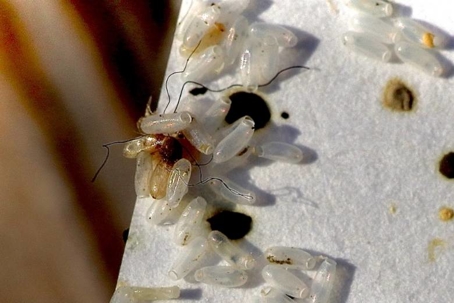
Do Bed Bugs Leave Droppings?
Yes, bed bugs definitely leave droppings. These droppings are one of the most reliable signs of an infestation. They are composed of digested blood and typically appear as tiny dark spots.
What Do Bed Bug Droppings Look Like?
Bed bug droppings, also known as bed bug poop, feces, or excrement, are one of the telltale signs of a bed bug infestation:
- Clustering tendency – Bed bug droppings are often found in groups or clusters, rather than scattered singly, reflecting the bugs’ tendency to hide in close quarters.
- Non-granular appearance – Unlike some insect frass that looks granular or powdery, bed bug droppings generally appear uniformly dense, often described as an “ink-like” deposit.
- Consistency/Texture – Bed bug droppings are soft and sticky when fresh because they consist of partially digested blood. Over time, they harden slightly but remain brittle compared with the firm pellets produced by other insects.
Moisture content – Fresh droppings are moist, which is why they may appear glossy or slightly wet initially. As they dry, they lose moisture and develop a matte or crusty texture.
Surface staining – On porous surfaces like fabric or unsealed wood, droppings can soak in, leaving faint stains that persist even after the droplet itself dries or crumbles.
Smearability – When fresh, droppings can smear easily if touched or pressed, leaving small streaks or smudges on surfaces like fabric, wood, or painted walls.
Faint halo or discoloration – In some cases, a slight halo or ring of discoloration may appear around dried droppings, particularly on light-colored fabrics, due to blood pigments spreading slightly during drying.
Bed bug droppings can be confused with other common household stains, so it's essential to look for other signs of bed bugs, such as live bugs, molted skins, eggs, or the characteristic sweet, musty odor that they emit. If you suspect a bed bug infestation, it's advisable to contact us for a thorough inspection and treatment.
What Size Are Bed Bug Droppings?
Bed bug droppings are typically very small, usually about 1–2 millimeters in diameter, roughly the size of a pinhead. They are dark brown to black in color because they consist of digested blood, and they often appear as tiny dots or smears on surfaces near where bed bugs hide. On fabrics, mattresses, sheets, or walls, they may look like small ink spots, and if wiped or pressed, they can leave a faint reddish-brown or black streak.
The size can vary slightly depending on the bed bug’s age and how recently it fed—adult droppings are slightly larger, while nymph droppings can be minuscule and harder to see. Their presence is often one of the earliest visible signs of an infestation, especially along mattress seams, bed frames, behind headboards, and in cracks and crevices near sleeping areas.
How Big Can Bed Bug Droppings Be?
Bed bug droppings are generally very small, but their maximum size depends on the bug’s age and feeding history. Fully fed adult bed bugs produce droppings that are typically around 1–2 millimeters in diameter, but in rare cases, if a bug has recently consumed a large blood meal, the droppings may be slightly larger—up to about 2–3 millimeters.
How Small Can Bed Bug Droppings Be?
Bed bug droppings can be extremely small, especially from nymphs (immature bed bugs) or recently fed young bugs. These droppings can be as tiny as less than 1 millimeter in diameter, sometimes almost microscopic to the naked eye. At this size, they may appear as fine black or dark brown specks, which can easily be mistaken for dirt, pepper, or tiny mold spots.
Because of their minuscule size, spotting them often requires careful inspection of areas where bed bugs hide: mattress seams, bed frames, headboards, behind baseboards, inside cracks and crevices, and even furniture joints. On porous surfaces like fabric, these tiny droppings may also leave faint stains or streaks rather than distinct dots.
What Color Are Bed Bug Droppings?
Bed bug droppings are dark in color, but the exact shade can vary depending on the bug’s age, feeding status, and how long the droppings have been there.
Because they are made of digested blood, droppings can change slightly over time, darkening as they dry. On light-colored fabrics, even tiny droppings can be very noticeable, whereas on dark surfaces they may blend in unless inspected closely.
Are Bed Bug Droppings Black?
Yes, bed bug droppings are typically black or very dark brown, though the exact shade can vary. On surfaces like mattresses, sheets, or furniture, they often look like tiny black dots or specks, sometimes smearing into faint streaks if pressed or rubbed.
The black color is one of the most reliable visual clues when inspecting for bed bug activity, especially along mattress seams, bed frames, baseboards, and cracks or crevices near sleeping areas.
Are Bed Bug Droppings Brown?
Yes, bed bug droppings can appear brown, particularly when they are fresh. Over time, as the droppings dry, they usually darken to very dark brown or black, which is the color most often noticed during inspections.
On fabrics or porous surfaces, fresh brown droppings can sometimes smear slightly, leaving faint streaks rather than distinct dots. Their color can help distinguish them from other debris, especially when found in clusters along mattress seams, bed frames, headboards, or cracks and crevices near sleeping areas.
Are Bed Bug Droppings Red?
Bed bug droppings are not truly red, but they can sometimes appear reddish-brown when very fresh. This occurs because they contain partially digested blood shortly after a feeding. The “red” tint is usually subtle and can be mistaken for small blood stains, but it quickly darkens as the droppings dry, turning dark brown or black.
So, if you notice tiny reddish-brown specks or smears along mattress seams, bed frames, or cracks near sleeping areas, it could indicate recent bed bug activity. Over time, these marks will almost always look black rather than red.
Are Bed Bug Droppings Gray?
Yes, bed bug droppings can sometimes appear gray, though this is less common. This usually happens when the droppings are:
Partially smeared or rubbed on a surface, which can lighten their appearance.
On porous or light-colored fabrics, where the dark color absorbs into fibers unevenly, making it look muted or grayish.
Older droppings that have dried out and lost some of their original dark intensity, especially if exposed to sunlight or cleaning attempts.
Bed bug droppings range from reddish-brown when fresh, to dark brown or black when dry, and grayish marks are usually a variant caused by surface interaction rather than the droppings themselves.
What Shape Are Bed Bug Droppings?
Bed bug droppings are generally small, round, or oval dots. On close inspection, they often appear as:
Tiny pinhead-sized spots (about 1–2 mm for adults, smaller for nymphs)
Slightly irregular or smudged shapes if the bug was moving while defecating or if the droppings have been smeared
Linear streaks on fabric or porous surfaces, caused by the droppings being pressed or smeared
Unlike some insect droppings that have a defined pellet shape, bed bug droppings are soft and flat, and their shape can vary depending on the surface they land on. They are typically found in clusters along hiding spots like mattress seams, bed frames, baseboards, and cracks.
Are Bed Bug Droppings Round?
Yes, bed bug droppings are generally round or oval in shape. They often appear as tiny, pinhead-sized dots, though their exact outline can be slightly irregular if smeared or pressed against a surface. On fabrics or porous surfaces, they may smear into small streaks, but the droppings themselves are naturally rounded rather than elongated or pellet-like.
This rounded, soft appearance—combined with their dark color and small size—is one of the key features that helps distinguish bed bug droppings from other insect or household debris.
Are Bed Bug Droppings Flat?
Yes, bed bug droppings are generally flat or slightly raised, rather than pellet-shaped like some other insect feces. Because they are made of digested blood, they tend to absorb slightly into porous surfaces like fabric or wood, forming tiny flat dots or smears.
On smooth, non-porous surfaces, fresh droppings may appear as small, soft droplets that can smear easily if touched. As they dry, they may become slightly crusty but still remain relatively flat.
This flatness, combined with their dark color and small size, is a key visual clue in identifying bed bug activity along mattress seams, bed frames, baseboards, and cracks or crevices.
Are Bed Bug Droppings Hard?
Bed bug droppings are not hard; they are usually soft and sticky when fresh because they consist of digested blood. On non-porous surfaces, fresh droppings can smear easily if touched, leaving small streaks or smears.
Over time, as the droppings dry, they harden slightly, but they generally remain brittle rather than solid like feces from some other insects. On porous surfaces like fabric or mattresses, they may soak in and leave stained spots that appear dry, but the substance itself is still relatively soft compared with something like insect frass from cockroaches.
This soft, sometimes smeared texture is one of the clues that help distinguish bed bug droppings from dirt or other tiny black specks.
Where Are Bed Bug Droppings Found?
Bed bug droppings, also known as fecal matter or excrement, are typically found in areas where bed bugs hide, feed, or rest. These pests tend to be most active during the night, and they leave behind droppings as they move and feed. Here are common places where you might find bed bug droppings:
Are Bed Bug Droppings Found On Mattresses?
On a mattress, bed bug droppings are most often concentrated in the areas where bed bugs hide during the day and travel to feed at night. The highest likelihood locations include:
Seams and piping – The stitched edges of the mattress are prime hiding spots, so droppings often appear along these lines.
Corners and edges – Bed bugs prefer the perimeter of the mattress rather than the middle, so droppings often accumulate near corners or along the sides.
Underneath the mattress – Bed bugs often hide between the mattress and box spring, leaving droppings on the underside.
Around tags or labels – Small folds or tags provide crevices where bed bugs can stay, and droppings often appear nearby.
Indented or creased areas – Any folds or depressions in the mattress surface can collect droppings, especially if bed bugs use these areas as pathways.
Droppings here typically appear as tiny dark spots or smears, sometimes forming clusters. Inspecting these areas carefully is one of the most effective ways to detect an infestation early.
Are Bed Bug Droppings Found On Bedding?
On bedding, bed bug droppings are typically found in areas where the bugs travel to feed or hide during the day, and where fabric provides slight creases or folds. The most common locations include:
Seams and edges of sheets and pillowcases – Bed bugs often crawl along stitching lines, leaving small dark dots along the seams.
Under folds or tucked-in sections – Any fabric that is tucked under the mattress or pillow can trap droppings.
Corners of the mattress or pillow – Bugs tend to favor edges and corners, so droppings often accumulate there.
Under pillows or along pillow edges – Bed bugs sometimes hide near the head of the bed, leaving droppings around pillow seams.
On blankets or comforters near sleeping areas – Especially along edges or where the blanket bunches up, droppings may be present as tiny specks or faint streaks.
On light-colored bedding, even tiny droppings are easier to see, appearing as small black or dark brown spots, sometimes smeared if the bug was moving while defecating. Inspecting all layers and edges of bedding carefully is crucial for identifying early infestations.
Are Bed Bug Droppings Found On Box Springs?
On a box spring, bed bug droppings are usually found in areas that provide dark, tight hiding spaces. Common locations include:
Seams and edges – Bed bugs often crawl along stitched seams, leaving droppings in lines or clusters.
Corners and perimeter – The edges and corners of the box spring are favored for hiding, so droppings frequently accumulate there.
Underneath the box spring – The underside, especially along the frame or support slats, often contains droppings.
Along the mattress-contact edges – Where the mattress rests on the box spring, bed bugs may leave droppings along the edges or in small gaps.
Inside or around fabric flaps or handles – Any openings, flaps, or handles sewn into the fabric covering can conceal bugs, and droppings are commonly found nearby.
Near weak points in the fabric cover – Tears, small holes, or worn spots are attractive hiding spots, and droppings may be visible around them.
Droppings here usually appear as tiny dark specks or faint smears, and clusters are common near high-traffic bug pathways. A thorough inspection of all these areas is critical for detecting bed bug activity in the box spring.
Are Bed Bug Droppings Found On Bed Frames?
On a bed frame, bed bug droppings are usually concentrated in areas that offer hiding spots or travel pathways. The most common locations include:
Corners and joints – The angles where the frame connects or folds often provide tight crevices where bed bugs hide, leaving droppings nearby.
Along seams or grooves – Any indents, notches, or decorative grooves in the frame can accumulate small dark spots.
Under the bed frame – The underside of side rails or slats is a prime location, especially along the edges where the frame meets the floor.
Near the headboard attachment points – Bed bugs often hide close to where the mattress meets the headboard, so droppings may be visible around screws, brackets, or slats.
Inside hollow areas – Some metal or wooden frames have hollow sections that serve as perfect harborage, with droppings found inside or along the openings.
Droppings on bed frames generally appear as tiny black or dark brown specks, sometimes forming clusters or faint smears. Careful inspection of these hiding-prone areas is essential for detecting bed bug activity.
Are Bed Bug Droppings Found On Headboards?
On a headboard, bed bug droppings are usually concentrated in areas that provide tight hiding spots or are close to where people sleep, since bed bugs prefer to stay near a food source. The most common locations include:
Corners and joints – Where the headboard meets the wall or where pieces are connected, offering small crevices for hiding.
Decorative grooves, seams, or indentations – Any carved or recessed areas can accumulate droppings.
Behind or under the headboard – The space between the headboard and the wall is a prime harborage zone.
Along edges and side panels – Bed bugs may crawl along edges, leaving small clusters of droppings.
Near attachment points – Screws, brackets, or slats that hold the headboard together can conceal bugs and their droppings.
Hollow sections or cavities – Some headboards have hollow areas that bed bugs use as shelter, often leaving droppings inside or along openings.
Droppings on headboards typically appear as tiny black or dark brown specks, sometimes smeared or clustered. Inspecting all edges, grooves, and hidden spaces is essential for detecting infestations.
Are Bed Bug Droppings Found On Bedside Furniture?
On bedside furniture such as nightstands, drawers, and small tables, bed bug droppings are typically found in hidden, dark, or undisturbed areas close to where people sleep. The most common locations include:
Along edges and corners – Bed bugs often crawl along edges and settle in tight corners, leaving tiny dark specks.
Inside drawers – Particularly in the back corners or along seams where the drawer meets the frame.
Behind or under furniture – The floor-facing base and the area between the furniture and the wall are prime harborage zones.
Underneath or behind decorative molding – Any grooves, trim, or raised sections can conceal bugs and droppings.
Near electrical outlets or cords – If cords run along or behind furniture, droppings may accumulate along these pathways.
In small crevices or joints – Where panels meet, screws are recessed, or the furniture has tiny gaps that are rarely disturbed.
Droppings here are usually tiny black or dark brown dots, sometimes forming clusters or faint smears if bugs are moving while defecating. Careful inspection of all edges, drawers, and hidden spaces is important for early detection.
Are Bed Bug Droppings Found On Couches?
On a couch, bed bug droppings are most commonly found in areas that provide hiding spots and are close to where people sit or rest, since bed bugs prefer to stay near a food source. Key locations include:
Seams and stitching – The lines where cushions are sewn together often harbor droppings.
Between cushions and the frame – The gap where cushions meet the base of the couch is a prime hiding area.
Under cushions – Bed bugs often retreat to the underside of cushions, leaving droppings on the fabric or cushion supports.
Corners and edges – Tight corners along the back, sides, or underneath the couch frequently accumulate droppings.
Crevices in armrests – Armrest seams, piping, or hollow sections can hide bugs and droppings.
Along the base or skirt – The area where the couch meets the floor, particularly behind or under the skirt, is often used as a pathway or hiding spot.
Inside or behind any removable fabric panels – If the couch has removable covers or decorative panels, bed bugs may leave droppings in these hidden spaces.
Droppings typically appear as tiny black or dark brown specks, sometimes forming clusters or faint smears, especially on light-colored fabric. Inspecting all seams, crevices, and undersides carefully is critical for detecting an infestation early.
Learn more: How To Get Rid Of Bed Bugs