
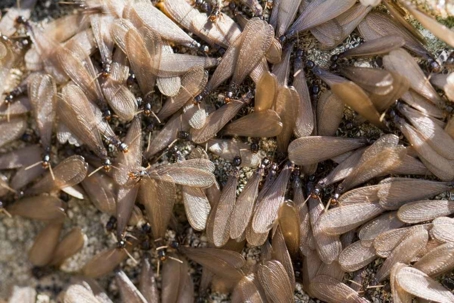
Termite swarms are essentially mating events. Colonies produce winged reproductives (alates) that leave to start new colonies. Spring is when many species are biologically primed for this dispersal phase.
- Temperature thresholds: Most subterranean termites become active when soil temperatures consistently rise into the mid-60s °F (≈18–20°C) and above. Winter keeps them deeper and less active; spring warmth brings them closer to the surface and triggers flight readiness.
- Moisture and humidity: Termites are highly susceptible to desiccation. Spring rains increase soil moisture and ambient humidity, creating safer conditions for alates to fly, land, shed wings, and survive long enough to pair up and find a nesting site.
- Calm weather windows: Swarms often occur on warm days following rain with light winds. These conditions reduce dehydration and improve the odds that pairs can settle successfully.
- Synchronized emergence: Colonies tend to release alates in large, coordinated bursts. Mass swarming overwhelms predators and increases the probability of successful mating—another reason it’s tied to predictable seasonal cues like spring weather patterns.
- Species-specific patterns: Not all termites swarm strictly in spring. For example, many subterranean species swarm in spring, while some drywood termites swarm later (summer to early fall, depending on region). The “spring swarm” observation is most typical for common subterranean species in temperate climates.
- Light attraction and timing: Alates are strongly attracted to light, so indoor sightings often occur around windows, doors, and light fixtures during daylight or at dusk. This doesn’t cause swarming but explains where people notice it.
A spring swarm indoors usually indicates an established colony in or immediately adjacent to the structure, not just a random event. Outdoors, it may be a nearby colony. Either way, it’s a cue to inspect for moisture issues, wood-to-soil contact, and potential entry points, and to consider treatment or monitoring.
When Else Do Termites Swarm?
In Washington DC, Maryland, and Northern Virginia, the dominant subterranean species (Eastern subterranean, Reticulitermes flavipes) peaks in spring—late March through May.
- Secondary window for subterraneans: There’s often a smaller, weather-dependent pulse in early fall (September–October). It’s not as consistent or as heavy as spring, but warm days after rain with mild nights can trigger localized swarms.
- Drywood termites (less common locally): Occasional introductions (e.g., via furniture) can produce summer to early fall swarms (July–October). These are sporadic in the Mid-Atlantic and usually tied to isolated infestations rather than widespread outdoor flights.
- Key environmental triggers across seasons: Regardless of month, flights line up with soil temps in the mid-60s °F and rising, high humidity, recent rainfall, and light winds. When those line up outside spring, you can still see off-cycle swarms.
In fall or summer sightings, indoors usually points to an active, nearby colony, while outdoor flights may be from adjacent properties. Off-season reports are worth inspecting, but expect lower frequency and smaller swarm sizes than spring.
Why Do Termites Swarm At Night?
Night air is cooler and more humid, which slows water loss. Winged termites desiccate quickly, so flying after sunset improves survival long enough to land, pair, and start a nest.
- Temperature control: Daytime surfaces can be too hot and drying. Evening temperatures are more stable and within the safe range for short flights and ground activity.
- Wind conditions: Winds often calm after dusk. Lighter, steadier air makes it easier for weak fliers to disperse and settle instead of being blown off-site.
- Predator pressure: Many daytime predators (birds, some insects) are less active at night. Swarming in the dark reduces immediate predation during the most vulnerable life stage.
- Species-specific timing: Not all termites are nocturnal swarmers. In the Mid-Atlantic, Eastern subterranean termites often swarm during daylight in spring, while Formosan subterranean termites typically swarm at dusk/night in late spring–early summer. The “night swarm” pattern depends on the species present.
Colonies use environmental cues—light level, humidity spikes after rain, and temperature thresholds—to release alates in coordinated bursts. For species keyed to dusk, that synchronization naturally lands at night.
Why Do Termites Swarm Around Lights?
Winged reproductives (alates) of many termite species are naturally attracted to light. Artificial lights act as strong visual beacons, pulling them toward buildings during a swarm.
- Orientation cue gone wrong: Termites evolved to use natural light gradients (sky brightness, moonlight) to orient during short dispersal flights. Intense, localized sources (porch lights, LEDs) disrupt that system, causing them to home in and circle.
- Dusk/night swarmer bias: Species that fly at dusk or night (e.g., Formosan subterranean termites) encounter artificial lighting during their peak activity, so aggregations around fixtures, windows, and illuminated entry points are common.
- Accumulation effect: Once a few alates gather, more follow the same cue. They collide with lit surfaces, drop their wings, and cluster—so the concentration looks larger than the actual number released at once.
- Shelter and entry points nearby: Lights are often mounted on structures with seams, gaps, and moisture sources. After being drawn in, alates land near door thresholds, window sills, soffits, or siding joints—places where a pair might attempt to establish.
- Not the root cause: Lights don’t create termites or trigger a swarm; they simply concentrate alates where you notice them. The colony is already in the soil or wood nearby.
Reducing nighttime attraction (turning off unnecessary exterior lights during peak swarms, using warmer-spectrum “bug” bulbs, moving fixtures away from entry points, and sealing/caulking gaps) can significantly cut down indoor incursions, even though it won’t affect the underlying colony.
Why Do Termites Swarm After It Rains?
Fresh rain drives relative humidity up and keeps it elevated for hours. Alates lose water rapidly; moist air lets them fly, land, and survive long enough to pair and start a nest.
- Soil is easier to colonize: Rain softens the top layer of soil and raises near-surface moisture. That makes it easier for a newly formed king and queen to excavate a small chamber and maintain the damp conditions termites require.
- Temperature + moisture cue: Many species key off a combination of warm temperatures and recent rainfall. A rain event after a warm-up acts as a reliable “go” signal that conditions are suitable across a wide area.
- Lower wind speeds: Post-storm periods often have lighter, steadier air. Weak fliers are less likely to be blown off-course, improving the odds of successful dispersal and settlement.
- Synchronized emergence advantage: When many colonies release alates at once after the same weather trigger, predators are overwhelmed. Even if many are eaten, enough survive to establish new colonies.
- Reduced surface hazards: Wet surfaces and shaded, damp microhabitats (mulch, leaf litter, cracks) provide immediate refuges for de-alates. Dry, sun-exposed conditions would kill many before they can burrow.
For Eastern subterranean termites in Washington DC, Maryland, and Northern Virginia, the classic pattern is a warm day following rain in spring, often late morning to afternoon. You may also see smaller pulses in early fall when similar moisture and temperature conditions line up.