
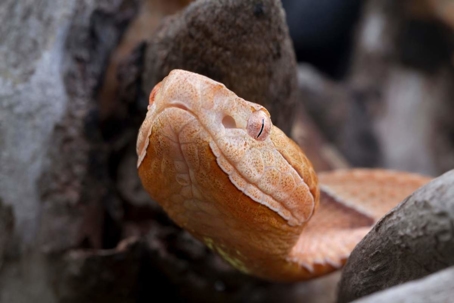
Do Copperhead Snakes Bite?
Copperhead snakes are generally not aggressive and prefer to avoid humans and pets, but these snakes will bite in certain situations. Understanding these scenarios can help you reduce risk:
Stepping on or near them: Copperheads are camouflaged well in leaf litter, grass, or forested areas. A person or pet stepping on one can trigger a defensive bite.
Touching or attempting to handle them: Even when they seem calm, picking up or cornering a copperhead often leads to a bite.
Cornered or Threatened: If a copperhead feels trapped with no escape route—such as in a small yard, garage, or enclosed area—it may bite to defend itself.
Protecting Young: Like many snakes, a copperhead near its nest or recently hatched young may strike if it perceives a threat.
Surprise Encounters in Outdoor Activities: Bites can occur when hiking, camping, or working in areas with tall grass, wood piles, rocks, or underbrush where snakes may be hiding. Pets running into brush or wooded areas can provoke defensive strikes from a hidden snake.
During Mating or Feeding Season Although less common, snakes may be more active and defensive during their mating season (spring to early summer) or when hunting prey, increasing the chance of accidental encounters.
Disturbing Hiding Spots: Moving logs, rocks, or piles of debris can startle a snake and trigger a bite.
Copperheads generally bite as a last resort—they are defensive, not aggressive predators toward humans or pets. Most bites happen because the snake is accidentally stepped on, cornered, or provoked. Pets, especially dogs, are at higher risk because their curiosity can lead them to approach or paw at a snake.
Copperhead Snake Bites
Copperhead snake bites are venomous, but typically less severe than bites from rattlesnakes or cottonmouths. However, they still pose significant health risks to both humans and pets:
Immediate Physical Effects
Pain and swelling: Usually at the bite site; can be intense and may spread up the limb.
Redness and bruising: Local tissue discoloration often develops within hours.
Blistering: Fluid-filled blisters may appear around the bite.
Warmth or tenderness: Common near the bite area.
Systemic Effects
Nausea and vomiting
Sweating and dizziness
Rapid heartbeat (tachycardia)
Low blood pressure (hypotension) in severe cases
Fainting or shock, especially in children, elderly, or pets
Severe or Complicated Risks
Allergic reactions: Some individuals may have an allergic response to the venom.
Infection: Secondary bacterial infections can develop if the wound is not properly cleaned.
Tissue damage (necrosis): Rare with copperheads, but prolonged swelling or untreated bites can cause localized tissue damage.
Compartment syndrome: In rare severe cases, swelling can restrict blood flow to muscles, requiring urgent medical intervention.
Special Considerations for Pets
Dogs and cats are more sensitive due to smaller body size relative to venom dose.
Rapid swelling of a limb or face, excessive drooling, lethargy, vomiting, or collapse requires immediate veterinary attention.
Long-Term Risks
Most copperhead bites heal fully with proper care.
Rarely, chronic pain, stiffness, or scarring can occur at the bite site.
Copperhead bites are rarely fatal to healthy adults but should always be treated as a medical emergency because of the risk of systemic symptoms, allergic reactions, or complications in pets, children, or immunocompromised individuals.
What Do Copperhead Snake Bites Look Like?
Copperhead snake bites have some characteristic features, though they can vary depending on the severity of the bite, location, and how long it’s been since the incident:
Bite Marks
Paired puncture wounds: Copperhead bites typically leave two small, widely spaced puncture marks, about 5–10 mm apart, where the fangs pierced the skin.
Possible minor scratches or abrasions: Sometimes the surrounding skin may show superficial scratches if the snake struck multiple times.
Local Reaction
Redness and swelling: Usually develops rapidly around the puncture site, often extending several inches beyond.
Pain or throbbing: The area can be tender, sharp, or even intensely painful.
Bruising: May appear within hours, sometimes spreading around the bitten limb.
Blistering: Fluid-filled blisters may form in the following 12–24 hours.
Severe Local Symptoms (Less Common)
Progressive swelling: The affected limb may swell significantly, sometimes reaching the hand, foot, or entire extremity.
Warmth and redness spreading up the limb: Indicates local venom effect.
Discoloration: The skin may take on a bluish or purplish hue if circulation is affected.
Systemic Signs (If Venom Is Absorbed)
Though not visible at the bite site, systemic symptoms can occur nausea, vomiting, or sweating, dizziness or fainting, and rapid heart rate or low blood pressure
Copperhead bites are sometimes mistaken for insect bites or minor cuts initially because the puncture marks are small and the pain can be mild at first. However, swelling and other symptoms typically progress within minutes to hours.
What To Do About Copperhead Snake Bites
If you are bitten by a copperhead snake, it’s important to treat it as a medical emergency, even though copperhead bites are rarely fatal. Prompt and proper care significantly reduces complications. Here’s what to do if you or someone else is bitten by a copperhead snake:
Stay Calm and Assess the Situation
Keep the victim calm — anxiety increases heart rate, which spreads venom faster.
Move away from the snake to prevent additional bites.
Call 911 or get to an emergency room immediately — antivenom is usually not required for mild copperhead bites but is sometimes needed for severe reactions, and medical assessment is essential.
Immobilize and Position the Affected Limb
Keep the bitten limb at or slightly below heart level.
Limit movement — movement increases venom circulation.
Avoid tight bandages or tourniquets; these can cause more harm than good.
Clean the Bite Area
Gently wash the bite with soap and water to reduce infection risk.
Do not apply ice directly; it can worsen tissue damage.
Do not cut or suck the wound — this is ineffective and increases infection risk.
Remove Constrictions
Remove rings, watches, or tight clothing near the bite site before swelling starts.
Monitor for Symptoms
Watch for signs of severe envenomation or allergic reaction:
Severe or rapidly spreading swelling
Nausea, vomiting, dizziness
Trouble breathing or swallowing
Weakness or fainting
If any of these occur, treat as a life-threatening emergency.
Pain Management
Over-the-counter pain relievers (acetaminophen) can help, but avoid aspirin or ibuprofen if you suspect a risk of bleeding.
Keep the limb elevated as tolerated.
Veterinary Care for Pets
If a dog or cat is bitten, get to a veterinarian immediately.
Signs of envenomation in pets include swelling, drooling, lethargy, vomiting, or collapse.
Do not attempt to catch or kill the snake. Identification is helpful but safety comes first. Immediate medical evaluation is essential, even for mild bites. Most copperhead bites are not life-threatening, but complications such as tissue damage, infection, or systemic symptoms can occur.