
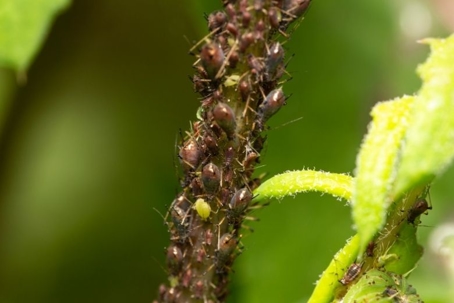
What Do Aphids Eat?
Aphids feed by piercing plant tissue and drawing out the nutrient-rich sap inside. Their primary food source is phloem sap, which flows through a plant’s vascular system and contains sugars, amino acids, and other soluble nutrients. Because this sap is diluted and high in sugar but low in protein, aphids must consume large volumes to meet their nutritional needs—this is why they produce so much sticky honeydew as a by-product.
They typically feed on:
Tender new growth such as young leaves, shoots, and flower buds
Soft stems where sap flow is strongest
Undersides of leaves, which provide easier access to veins and protection from predators
A wide range of host plants, including vegetables, ornamentals, fruit trees, and field crops
Different aphid species may specialize on certain plants, but overall, any plant with accessible phloem sap can become a food source.
Do Aphids Eat Plants?
Aphids are highly adaptable and feed on an enormous range of plants, but they tend to concentrate on species with tender, fast-growing tissue and abundant sap flow. In general, they are most likely to settle on plants that produce soft new growth, have lush foliage, or experience nitrogen-rich fertilization. Vegetables commonly targeted include peppers, tomatoes, cucumbers, squash, beans, lettuce, and brassicas such as cabbage, kale, and broccoli. In gardens and landscapes, they favor roses, hibiscus, hydrangeas, chrysanthemums, and many annual flowers with succulent stems. Fruit trees—including apples, peaches, plums, and citrus—often host specialized aphid species that colonize buds, leaves, and developing shoots early in the season.
Herbs with softer foliage, such as basil or dill, are frequent hosts, while woodier or highly aromatic plants like rosemary, sage, and lavender tend to be less appealing. In agricultural settings, aphids thrive on crops such as cotton, potatoes, wheat, soybeans, and alfalfa, where dense plantings and abundant nutrients allow colonies to expand quickly. Although some species are highly host-specific, many will shift to a wide array of ornamental or crop plants whenever conditions favor rapid plant growth.
Do Aphids Eat Fruits?
Aphids don’t truly “eat” fruits themselves, but they aggressively feed on the new leaves, shoots, buds, and flower clusters of many fruit-bearing plants. Their feeding weakens growth, curls leaves, distorts fruit development, and spreads plant viruses. Certain fruit crops are especially attractive because they push out soft, nutrient-rich growth that aphids can tap into easily. Here are some of the fruits most commonly targeted by aphids:
- Apples – Green apple aphids and rosy apple aphids colonize young shoots and leaf bases early in spring.
- Peaches, nectarines, apricots, and plums – Stone fruits are prime hosts; black peach aphids and other species cluster heavily on tender shoot tips.
- Cherries – Black cherry aphids often cause dramatic leaf curling and stunted shoots.
- Citrus (orange, lemon, lime, grapefruit) – Soft flushes of new foliage are highly attractive to several aphid species.
- Pears – Pear psylla is the primary pest, but aphids also attack young foliage and developing buds.
- Strawberries – Colonies gather on leaf undersides and flower stems, potentially affecting fruit set.
- Raspberries and blackberries – Aphids congregate on the tender cane tips and undersides of expanding leaves.
- Grapes – Not as heavily targeted as tree fruit, but some species feed on new leaf growth and inflorescences.
- Melons (cantaloupe, watermelon, honeydew) – Technically vegetables, but grown as fruits; they are highly susceptible due to rapid vine growth and abundant sap.
Fruits less commonly affected: blueberries, cranberries, currants, gooseberries, figs, and pomegranates—though they can still get aphids under favorable conditions.
Do Aphids Eat Vegetables?
Aphids gravitate toward vegetables that offer soft, nutrient-rich growth, especially young leaves and tender stems. In home gardens and commercial plantings, they are most frequently found on brassicas such as cabbage, kale, broccoli, cauliflower, collards, and Brussels sprouts, where the dense, succulent growth gives them easy access to sap. They also favor cucurbits—cucumbers, squash, zucchini, pumpkins, and melons—because the vines produce rapid new growth that aphids can colonize quickly. Nightshades, particularly peppers, eggplant, and tomatoes, are common hosts, with colonies forming on the undersides of leaves and in sheltered nodes. Beans and peas are also high on their list, as the lush foliage and high nitrogen levels make them ideal feeding sites. Leafy greens such as lettuce, spinach, Swiss chard, and bok choy are frequent targets, especially during cool, moist weather that supports aphid reproduction. Root crops with leafy tops, like carrots and beets, can attract them as well, though usually not as intensely as the more tender, fast-growing vegetables.
Do Aphids Eat Herbs?
Aphids do feed on herbs, but they show clear preferences based on how soft, tender, and aromatic the foliage is. They are far more attracted to mild, succulent herbs and tend to avoid strongly scented, resinous, or woody species.
Common herbs aphids are most likely to attack:
Basil – One of the most aphid-prone herbs; its soft leaves and fast growth make it an easy target.
Mint – Despite its strong scent, its lush, tender shoots attract several aphid species.
Cilantro (coriander) – Young foliage and stems can host colonies, especially in cool weather.
Dill – Soft, feathery growth is appealing to aphids, particularly early in the season.
Parsley – Curly and flat-leaf types both draw aphids when growth is dense and fresh.
Chervil – Similar to parsley and dill, with tender shoots aphids readily exploit.
Fennel – Attracts plant-specific aphids that feed on its fine foliage and stems.
Lemon balm – Soft new tips are particularly vulnerable during spring flushes.
Herbs aphids are less likely to bother:
Rosemary
Thyme
Sage
Lavender
Oregano
Marjoram
These aromatic, woody herbs contain high concentrations of essential oils that deter aphids and make their leaves more difficult to feed on.
Do Aphids Eat Wood?
Aphids cannot feed on wood. Their mouthparts are designed to slip between plant cells and tap directly into phloem sap, which flows only in soft, living tissues. Wood is dense, hardened, and lacks accessible sap, so it’s impossible for aphids to penetrate or use it as a food source.
They stay on:
Tender new leaves
Soft stems
Young shoots
Flower buds
Undersides of foliage where veins are close to the surface
If you ever find insects on wood, they’re almost certainly not aphids—you’re more likely looking at barklice, scale insects, termites, or certain beetles, depending on what the material looks like.
Do Aphids Eat Insects?
Aphids do not feed on other arthropods. They are strictly phloem-sap feeders, biologically specialized for tapping into plant tissues and extracting liquid nutrients. Their mouthparts, digestive system, and entire life strategy are built around plant feeding, not predation or scavenging.
No aphid species has evolved to feed on any animal tissue. They lack the physical structures and digestive enzymes needed to consume or benefit from animal material, whether arthropods or otherwise.
Aphids are obligate plant feeders; their entire ecology revolves around plants, never other arthropods. If you're seeing small soft-bodied insects feeding on other insects, it's almost certainly not aphids but something else—possibly predatory bugs, larvae, or mites.