
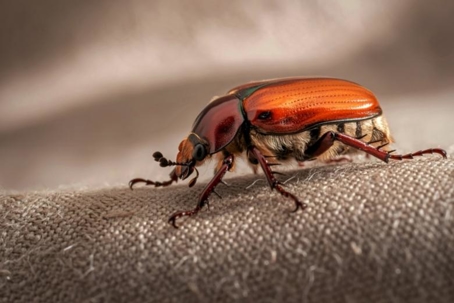
Can June Beetles Bite?
June beetles (also called June bugs, belonging to the genus Phyllophaga) are generally harmless to humans and pets. These beetles are primarily plant feeders and do not seek out animals to bite. However, there are a few points to note:
Biting ability: Adult June beetles do have mandibles (jaws), and in rare cases, they might nip if handled roughly or provoked. The bite is usually superficial, causing minor discomfort at most, not true “bites” in the sense of feeding on blood.
Risk to pets: Pets are highly unlikely to be bitten. Dogs or cats might try to catch them, but the beetles are more likely to be tossed around or eaten than to bite. The worst-case scenario is minor irritation in a pet’s mouth.
Allergic or skin reactions: On very rare occasions, if a beetle’s mandibles break the skin, a mild reaction could occur—redness, slight swelling, or itching—but serious reactions are extremely uncommon.
June beetles are not considered biting pests. If you or your pet are experiencing actual bites or rashes, it’s more likely from other insects like fleas, ticks, or certain beetle larvae rather than adult June beetles.
Do June Beetles Bite?
June beetles are generally docile and not aggressive toward humans or pets, so “bites” are extremely rare. When they do occur, it’s usually in very specific situations:
Handling or rough contact: If a person picks up a June beetle or tries to hold it, the beetle may use its mandibles defensively. This can happen if someone accidentally traps it between fingers or clothing.
Pet interactions: Dogs or cats may try to play with or chew on a June beetle. The beetle might attempt to defend itself with a nip, but this is usually very mild and rarely breaks the skin.
Disturbing them during feeding: June beetles feed on plant material at night, particularly leaves, grass, or flowers. If accidentally disturbed while eating (for example, in a garden), they might try to nip in self-defense.
Trapped or cornered beetles: If a beetle is trapped between objects, on a person’s skin, or in clothing, it may bite reflexively to escape.
The “bite” is more of a defensive pinch and not intended to feed on humans or pets. Any reaction from skin contact is usually minor—slight redness or irritation. Serious injuries, allergic reactions, or disease transmission from June beetles are essentially nonexistent.
June Beetle Bites
The risks associated with June beetle “bites” are extremely minimal. These insects are not blood-feeding, venomous, or carriers of disease, so any risk is largely minor and localized:
Skin irritation: A bite or pinch from a June beetle may cause slight redness, minor swelling, or itching at the site. In most cases, this resolves within a few hours without treatment.
Allergic reactions: True allergic reactions are extremely rare. Sensitive individuals might develop mild hives or localized itching, but systemic reactions (like difficulty breathing) are virtually unheard of.
Infection risk: Any skin break carries a tiny risk of secondary bacterial infection. This is not specific to June beetles; it’s the same risk as from any minor scratch or cut. Keeping the area clean is sufficient.
Pet interactions: If a pet is bitten, it may experience brief discomfort or paw at its mouth. Serious injury or illness from a June beetle bite to a pet is not known to occur.
For humans and pets, June beetle bites are mostly harmless. The main concerns are minor skin irritation or the extremely rare allergic reaction. No long-term health risks, toxins, or diseases are associated with them.
What Do June Beetle Bites Look Like?
Actual bites from June beetles are very rare, and when they do occur, they are minor. Because June beetles are not blood-feeding insects, what you see is usually a small superficial mark rather than a true “bite wound.” Here’s what to expect:
Appearance: Small red or pink pinprick-like mark. Slight swelling around the area is possible. In some cases, a tiny bruise or mild irritation may appear if the beetle’s mandibles pinch the skin.
Texture or sensation: The skin may feel tender or slightly itchy. Some people report a mild stinging or burning sensation at the site for a short time.
Duration: The mark typically resolves within a few hours to a day. Rarely, mild redness or itching can persist for a couple of days.
Secondary issues: If scratched excessively, there is a slight risk of minor infection. There is no blistering, pus, or significant tissue damage associated with June beetle pinches.
Comparison: These “bites” are much less noticeable than those from fleas, bed bugs, or mosquitoes. Often, what people think is a June beetle bite is actually irritation from contact with another insect or plant.
What To Do About June Beetle Bites
If you get pinched or “bitten” by a June beetle, the situation is almost always minor. Here’s a professional step-by-step approach:
Clean the area: Wash the skin gently with soap and warm water to remove any bacteria or debris. Pat dry with a clean towel.
Apply a cold compress (optional): If there’s mild swelling or tenderness, apply a cool cloth or ice pack for 5–10 minutes. This helps reduce irritation and redness.
Use over-the-counter remedies if needed: For itching or minor discomfort, a small amount of hydrocortisone cream or an anti-itch lotion (like calamine) can help. Oral antihistamines are generally unnecessary unless there is unusual itching.
Monitor for infection or allergic reaction: Watch for signs of infection: increasing redness, warmth, swelling, pus, or pain. Allergic reactions are extremely rare but would include widespread hives, swelling, or difficulty breathing. If any severe reaction occurs, seek medical attention immediately.
Avoid scratching: Scratching can break the skin and increase the risk of infection.
Prevent future contact: Avoid handling the beetle directly. Keep pets from chewing or catching them, as the beetle may pinch in self-defense.
June beetle “bites” are minor, self-limiting, and rarely cause serious issues. Standard wound care and monitoring are sufficient in nearly all cases.