
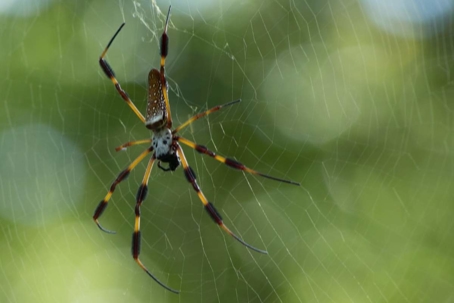
Do Banana Spiders Bite?
Banana spiders—whether you’re referring to the large orb-weavers commonly called banana spiders in the U.S. (Nephila/Trichonephila) or the less common Brazilian wandering spider sometimes found in imported produce—are generally reluctant to bite. Their defensive bites almost always occur under specific kinds of pressure or unexpected contact.
Here are the situations in which these spiders are most likely to bite:
- When they are accidentally grabbed or pressed against the skin: Most bites happen when someone brushes a hand, arm, or leg against the spider while gardening, clearing brush, working in sheds, or reaching into dark, cluttered spaces.
- When their web is disturbed at close range: Orb-weaver banana spiders build large, strong webs. If a person walks directly into the web or tries to remove the spider by hand, the spider may respond defensively.
- When they are trapped in clothing or gear: If a banana spider crawls into shoes, gloves, hats, or yard equipment and becomes trapped against the body when the item is put on, it may bite as a last resort.
- During direct handling: They are not aggressive, but attempts to pick them up, move them, or pin them down can provoke a defensive bite.
- When protecting an egg sac (rare): Females guarding egg sacs may act more defensively, though even then they prefer escape over confrontation.
Bites from orb-weaver banana spiders are rare and mild, usually comparable to a bee sting. The dangerous Brazilian wandering spider—often confused with the harmless orb-weaver—is extremely unlikely to be encountered in normal North American settings.
Banana Spider Bites
Bites from the spiders commonly called banana spiders in the United States—large golden orb-weavers (Trichonephila/Nephila species)—are medically minor in almost all cases. These spiders are non-aggressive, their venom is weak, and their bites rarely cause more than brief local discomfort.
Here is the severity and associated risks for the different spiders that may be labeled “banana spiders,” since the name is used for both harmless orb-weavers and the much more dangerous Brazilian wandering spider.
Orb-Weaver Banana Spiders (Common in the U.S.)
Severity
Their bite is considered mild. Most people experience pain similar to a bee sting—sharp at first, then fading within minutes to hours.
Typical Symptoms
Localized redness
Mild swelling
Warmth at the bite site
Slight itching or tenderness
Symptoms may last a few hours to, at most, a day or two.
Risks
No significant medical complications
No necrosis
No systemic effects
No long-term issues
These spiders do not pose a danger to pets or humans outside of rare allergic reactions, which are possible with any arthropod bite or sting but extremely uncommon.
Brazilian Wandering Spiders (True “banana spiders” in imported produce)
These spiders can be dangerous, but encountering them in North America is extraordinarily rare. Almost all “banana spider in the grocery store” stories turn out to be harmless species.
Severity
Their venom can cause significant pain and, in rare untreated cases, systemic reactions.
Potential Risks
Intense pain at the bite site
Muscle cramping
Elevated heart rate or blood pressure
Nausea or sweating
Rare severe systemic envenomation requiring medical care
Again, this scenario is highly unlikely unless the spider is positively identified as Phoneutria.
For the orb-weaver banana spiders most people see outdoors or in gardens, the risk is extremely low, the bite is minor, and symptoms are short-lived. Serious reactions are virtually unheard of.
What Do Banana Spider Bites Look Like?
A bite from the banana spiders commonly found in the United States—golden orb-weavers—typically looks mild and uncomplicated. Most bites resemble a small, localized skin irritation rather than anything dramatic or dangerous.
You can expect a small red spot at the bite site, sometimes accompanied by slight swelling and mild tenderness. The area may appear a bit warm to the touch and can itch lightly as it begins to resolve. In most cases, the reaction looks similar to a minor ant bite or a mild bee sting and fades within a few hours to a day. These spiders do not cause spreading redness, tissue breakdown, or blistering.
If someone did encounter the far rarer Brazilian wandering spider—often also called a banana spider—the bite would appear more inflamed and painful, usually with a distinct puncture site and a wider area of redness. Even then, severe skin damage is not typical; the major concern with those spiders is systemic symptoms, not the appearance of the bite.
What To Do About Banana Spider Bites
If you’re bitten by a banana spider—almost always the harmless golden orb-weaver—the situation is usually minor and easily managed at home. These spiders are not aggressive, and their venom is weak, so treatment focuses on comfort and basic wound care.
Here’s what to do:
- Clean the bite gently: Wash the area with soap and warm water to remove any dirt or bacteria. This helps prevent secondary infection, which is the most common complication of any minor bite.
- Apply a cold compress: A cold pack or a cloth with ice wrapped inside reduces swelling, redness, and discomfort. Use it for 10–15 minutes at a time.
- Manage pain or itching if needed: Over-the-counter options like acetaminophen, ibuprofen, or a topical anti-itch cream (hydrocortisone or calamine) can help if the site is bothersome.
- Avoid scratching: Scratching can break the skin and lead to infection. Keeping the area clean and dry helps it heal faster.
- Monitor briefly for anything unusual: Orb-weaver bites don’t cause severe reactions, so lingering pain, spreading redness, pus, or fever are signs of infection—not venom effects. Seek medical attention if you notice any of these.
If the bite is from a confirmed or strongly suspected Phoneutria species—something typically only seen in imported produce from South America—seek medical care immediately. Symptoms such as severe pain, sweating, nausea, or muscle spasms require prompt evaluation, but this scenario is extraordinarily uncommon.