
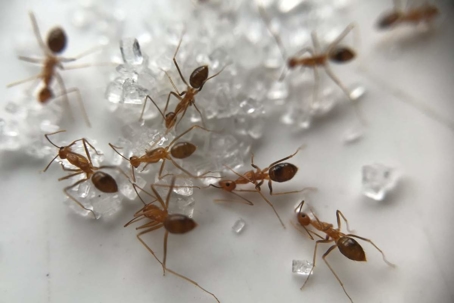
Do Ants Eat Baking Soda And Sugar?
Ants are strongly attracted to sugar because it is a high-energy food source, especially worker ants that forage for carbohydrates to bring back to the colony. When baking soda is mixed with sugar, the sugar acts as a bait, encouraging ants to consume the mixture and carry portions of it back to their nest.
Baking soda itself is not attractive to ants. On its own, baking soda does not draw ants and they will typically ignore it. The effectiveness of the mixture relies entirely on the sugar masking the baking soda and luring the ants into ingesting it. Without sugar or another sweet attractant, ants are unlikely to interact with baking soda at all.
The intended effect comes from ingestion, not contact. The theory behind this method is that when ants consume baking soda, it reacts with the acids in their digestive system, producing gas. Because ants cannot expel gas effectively, this internal reaction can be fatal to individual ants. However, this process is slow, inconsistent, and depends on the ants consuming a sufficient amount.
While some ants may die after eating the sugar and baking soda mixture, it rarely impacts the queen or eliminates the colony. Many ants may consume only the sugar portion, and the bait is not designed to spread efficiently through the colony like professional ant baits formulated with slow-acting toxicants.
Does Baking Soda Kill Ants?
Baking soda is not inherently toxic to ants on contact. For it to be lethal, ants must ingest it, typically when it is mixed with an attractant such as sugar that encourages consumption.
The proposed killing mechanism is internal, not immediate. When ants ingest baking soda, it may react with acids in their digestive system and produce gas. Because ants cannot release gas efficiently, internal pressure can build and eventually kill the individual ant. This process is slow and inconsistent, and it does not affect ants that merely walk over the powder.
Baking soda is unreliable and inefficient as a control method. Many ants consume only small amounts or avoid the baking soda altogether. Others may feed on the sugar portion and discard the baking soda, limiting its effectiveness. As a result, only a small percentage of foraging ants are typically affected.
It does not eliminate ant colonies. Baking soda does not spread through the colony via food sharing in a reliable way, and it does not reach or kill the queen. At best, it may reduce visible worker activity temporarily, but the colony quickly replaces lost ants.
While it can kill some individual ants under ideal conditions, baking soda is not a dependable solution for ant infestations. Effective ant control requires baits or treatments designed to exploit colony behavior and deliver lethal doses back to the nest.
How Long Does Baking Soda Take To Kill Ants?
The effect of baking soda on ants is slow and inconsistent. Baking soda does not kill ants on contact—it must be ingested. Even when ants consume a sugar-and-baking soda mixture, the lethal effect depends on the amount eaten and the individual ant’s physiology, so results vary widely.
Individual ants may die within hours to a few days. Ingestion can cause internal gas formation when baking soda reacts with digestive acids, leading to death. Some ants may die within several hours, while others may survive for one to two days after consuming the mixture. There is no precise or guaranteed timeframe.
Colony-level impact is minimal. Because baking soda does not reliably spread through food sharing (trophallaxis), the queen and most workers are unlikely to ingest lethal amounts. Even if some foragers die, the colony continues functioning, so observable ant activity may only decrease temporarily.
Effectiveness depends on bait placement and consumption. If the sugar-baking soda mixture is placed where ants actively forage, more ants may ingest it, slightly improving results. However, ants often separate the sugar from the baking soda, limiting ingestion and delaying or preventing death.
Does Sugar Kill Ants?
Sugar by itself does not kill ants. Sugar is a food source for ants, providing energy for foraging workers and the colony. Alone, it attracts ants but has no toxic or lethal effect on them. In fact, offering plain sugar usually encourages more ant activity rather than reducing it.
Sugar is often used in ant baits as an attractant. When mixed with a toxicant, sugar lures ants to consume the bait and carry it back to the colony. In this context, the sugar itself is harmless, but it enables the poison to reach the queen and other workers through food sharing.
Ingestion of sugar without a toxic additive does not harm ants. Ants may consume large amounts of sugar and continue thriving. Using sugar alone as a “control method” will not reduce an infestation; it only increases ant traffic.
Baking Soda And Sugar For Ants
Baking soda and sugar should be viewed as a short-term, low-level control method, not a true solution for eliminating an ant infestation. The goal is to lure foraging ants to ingest baking soda using sugar as an attractant, knowing it may only affect a small number of workers and not the colony itself.
Use a fine, even mixture to improve ingestion. Mix equal parts powdered sugar and baking soda thoroughly. Powdered sugar is preferred because it blends more uniformly with baking soda, making it harder for ants to separate the sugar from the baking soda while feeding.
Place the mixture directly in ant activity areas. Sprinkle small amounts along active ant trails, near entry points such as cracks, baseboards, window sills, or where ants are consistently foraging. Avoid placing large piles; thin, scattered placements increase the chance ants will interact with and ingest the mixture.
Keep the mixture dry and undisturbed. Moisture reduces effectiveness by causing clumping, and ants may avoid damp or spoiled bait. Do not spray cleaners or water near the placement areas, and refresh the mixture every few days to maintain attractiveness.
Use containment if cleanliness is a concern. Shallow bottle caps, jar lids, or small pieces of cardboard can be used to hold the mixture neatly in place. This helps prevent scattering while still allowing ants easy access.
Monitor results realistically. You may observe a temporary reduction in visible ants after several days, but activity often returns once new workers replace those lost. If ant traffic does not noticeably decline within a week, the mixture is not working effectively.
Because this approach does not reliably reach the queen or spread throughout the colony, it is best suited for minor, occasional ant activity. Persistent or heavy infestations require targeted baiting strategies designed to eliminate the colony at its source.
Killing Ants With Baking Soda
Baking soda is generally safe to use around the home when targeting ants. Baking soda (sodium bicarbonate) is non-toxic to humans and pets in typical household amounts. When used as an ant control method, it poses far fewer health risks than chemical insecticides, especially in kitchens, pantries, or areas where food is prepared:
It is safe for people and pets when used properly. Incidental contact with baking soda is harmless, and small accidental ingestion by pets or children is unlikely to cause serious harm. That said, large amounts should not be left where pets may intentionally consume it, as excessive ingestion can cause digestive upset.
There is no risk from contact exposure. Baking soda does not kill ants through contact, nor does it irritate human skin or release harmful fumes. It can be safely placed along baseboards, cracks, and entry points without special protective equipment.
The main safety consideration is effectiveness, not toxicity. While safe, baking soda is not a powerful or reliable ant control product. It requires ingestion by ants and does not spread through the colony, meaning infestations often persist despite repeated use.
Compared to commercial pesticides, baking soda is low risk but also low impact. From a professional pest management standpoint, baking soda is one of the safest options available but also one of the least effective. It may be appropriate in homes seeking a non-chemical approach, as long as expectations are realistic.
Baking soda is safe but limited. It does not pose significant health or environmental risks when used correctly, making it a safe option for minor ant activity. However, safety does not equal effectiveness, and it should not be relied upon for eliminating established ant colonies