
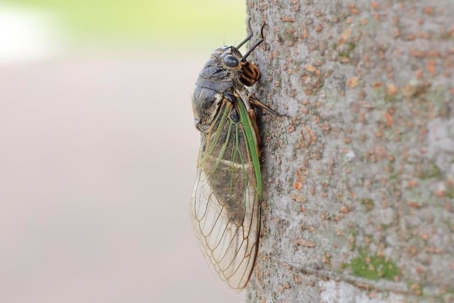
Do Cicadas Eat?
Yes. Cicadas primarily feed on plant fluids, using their specialized mouthparts to pierce stems, roots, and branches to extract sap. The feeding of these bugs generally causes minimal harm to mature plants, but young trees and shrubs can experience damage if heavily infested.
Do Adult Cicadas Eat?
Adult cicadas do feed, but their diet is relatively limited compared to their nymph stage. Using specialized piercing-sucking mouthparts, adults extract plant fluids, primarily xylem sap, from stems, branches, and sometimes leaves. However, their feeding is largely opportunistic and sporadic, as adults focus primarily on mating and reproduction rather than sustained nutrition. Because xylem sap is low in nutrients, adult cicadas do not consume large quantities, and their short adult lifespan—typically a few weeks—means that feeding is less critical for survival. While adult feeding can cause minor damage such as small scars on twigs or branches, it rarely has a significant impact on healthy, mature trees. Young or stressed plants, however, may be more vulnerable if many cicadas feed simultaneously. Adult cicadas rely more on the energy reserves accumulated during their prolonged nymph stage than on active feeding.
Do Cicada Nymphs Eat?
Cicada nymphs are voracious feeders that sustain themselves underground for the majority of their life, which can range from two to seventeen years depending on the species. They feed by inserting their specialized piercing-sucking mouthparts into plant roots, drawing xylem sap to obtain water and nutrients necessary for growth and development. Although xylem sap is low in calories and nutrients, nymphs are highly efficient at extracting what they need over extended periods, which allows them to grow slowly and store energy for their transformation into adults. Their feeding activity typically does not kill plants, but heavy infestations around young or small trees can cause stunted growth or root stress. Nymphs rely entirely on this subterranean diet, as they are incapable of surviving above ground until they emerge to molt into adults, making root feeding essential to completing their long developmental cycle.
What Do Cicadas Eat?
Cicadas generally prefer woody trees and shrubs, including oaks, maples, dogwoods, and fruit trees. They avoid herbaceous plants and grasses, as these usually do not provide sufficient xylem sap for sustenance.
Impact on Plants: While cicadas feed, the actual damage to trees is usually minimal. Nymph feeding underground may slightly stress roots, but the most noticeable impact comes from adult females laying eggs in small branches, which can cause twig dieback.
Nutritional Adaptations: To extract sufficient nutrients from nutrient-poor xylem sap, cicadas rely on symbiotic bacteria in their bodies that help synthesize essential amino acids. This adaptation allows them to survive on a diet that is otherwise deficient in critical nutrients.
Cicadas only feed during certain stages of their life cycle. Underground nymphs feed continuously for years, while adults, which live only a few weeks, feed intermittently and focus mainly on reproductive activities rather than prolonged feeding.
What Do Cicada Nymphs Eat?
Cicada nymphs primarily feed on the xylem sap of plant roots while living underground, a diet that is rich in water but very low in nutrients. Using specialized piercing-sucking mouthparts called stylets, they attach to the roots of trees and shrubs to extract the fluid, which provides them with the energy needed for growth and development over several years, depending on the species. Because xylem sap is nutrient-poor, nymphs rely on symbiotic bacteria within their bodies to synthesize essential amino acids, enabling them to survive on such a restrictive diet. They show a preference for the roots of woody plants, including oaks, maples, and fruit trees, while generally avoiding herbaceous plants and grasses that cannot supply sufficient xylem sap. Throughout their underground development, nymphs remain largely hidden, feeding continuously and gradually growing through successive molts until they are ready to emerge as adults. Despite their long-term feeding, the actual impact on plant health is usually minimal, although heavy infestations may slightly stress root systems.
What Do Adult Cicadas Eat?
Adult cicadas feed primarily on the sap of trees and woody shrubs, using the same specialized piercing-sucking mouthparts, or stylets, that they used as nymphs. Unlike nymphs, which feed on roots underground, adults extract fluids from stems, branches, and sometimes the trunk, targeting xylem sap that is nutrient-poor but abundant in water. Their feeding is intermittent and generally less intensive than that of nymphs, as adults have a relatively short lifespan—typically just a few weeks—during which their main focus is reproduction rather than prolonged feeding. They prefer deciduous trees such as oaks, maples, dogwoods, and fruit trees, avoiding herbaceous plants that do not provide sufficient sap. While their feeding rarely causes significant harm, females may create small slits in branches to lay eggs, which can result in minor twig dieback. Like nymphs, adult cicadas rely on symbiotic bacteria to supplement the sparse nutrients in xylem sap, allowing them to sustain their energy needs and support mating and egg-laying activities during their brief adult stage.
What Plants Do Cicadas Eat?
Cicadas are sap feeders, and their preferences are generally tied to woody plants with accessible xylem sap. Their feeding is usually non-destructive, but females can damage twigs during egg-laying. Different species may have slight preferences, but the following are commonly targeted:
Do Cicadas Eat Deciduous Trees?
Cicadas, especially the periodical species (like the 13- and 17-year cicadas in North America), tend to prefer deciduous trees with well-developed root systems because the nymphs feed on xylem sap from the roots. While they are not overly picky, they do show preferences for certain genera, particularly those that provide easier access to sap and sufficient nutrient flow.
Here are some of the more common deciduous trees that cicadas are most likely to feed on:
Maples (Acer spp.): Sugar maple, red maple, silver maple. These have extensive root systems and abundant xylem flow, making them a frequent target for nymphs.
Oaks (Quercus spp.): White oak, red oak, pin oak. Oaks are often favored because of their deep roots and high sap availability.
Elms (Ulmus spp.): American elm, slippery elm. Nymphs can thrive on their roots, and adults may also feed slightly on twigs.
Hickories and Pecans (Carya spp.): Shagbark hickory, pecan. These hardwoods are commonly targeted for sap extraction by underground nymphs.
Ash (Fraxinus spp.): White ash, green ash. Another group with deep roots suitable for cicada nymphs.
Cherry and Plum (Prunus spp.): Wild cherry, black cherry, and cultivated fruit trees. Occasionally targeted by nymphs; adults may also puncture twigs to feed slightly.
Dogwood (Cornus spp.): Smaller trees, but their roots are often accessed in areas with dense populations of cicadas.
Cicadas rarely feed on conifers because their xylem sap has different chemical properties and is less nutritious. Soil moisture and root accessibility matter more than the exact species; trees in well-drained, loamy soils are more frequently targeted. While nymphs feed underground, adults may create small superficial damage on twigs when feeding or laying eggs, which is often noticed in the same preferred species.
Do Cicadas Eat Fruit Trees?
Cicadas, particularly periodical species, generally feed on the roots of trees, so fruit trees are at risk primarily at the nymph stage underground. Adults may also feed lightly on twigs, leaves, or branches, but damage is usually minor compared to egg-laying scars. Here are some of the fruit trees cicadas are most likely to target:
High Likelihood of Feeding
Apple (Malus domestica): Apples have extensive root systems and are commonly affected by nymph feeding underground. Adults may leave small puncture marks on young branches while feeding or ovipositing.
Peach and Nectarine (Prunus persica): Shallow roots can attract nymphs. Twigs and small branches are often damaged by adult egg-laying, leading to “flagging” (wilting of branch tips).
Cherry (Prunus spp.): Sweet and sour cherry trees are often targeted underground. Adult feeding is minimal, but twig scarring from egg-laying is common.
Plum (Prunus domestica / Prunus americana): Similar to cherries; roots are targeted by nymphs, adults create minor twig damage.
Moderate Likelihood
Pear (Pyrus spp.): Nymphs feed on roots but usually less intensively than on apples or peaches. Adult damage is typically limited to small twig punctures.
Apricot (Prunus armeniaca): Roots may attract nymphs; twig scarring from adult oviposition is occasional.
Fig (Ficus carica): Less commonly affected, but shallow-rooted figs can support nymph feeding.
Lower Likelihood
Plumcot / Hybrid stone fruits: Usually feed lightly; susceptible mainly if trees are young and roots are easily accessed.
Citrus (Citrus spp.): Rarely fed on; cicadas prefer deciduous temperate trees rather than evergreen subtropical roots.
Damage to fruit trees comes mostly from egg-laying on branches (adults) rather than feeding. Root feeding by nymphs usually doesn’t kill mature trees, but it can stress young trees, especially in large broods. Softwood branches and twigs are more vulnerable to cicada damage than thick, mature branches.
Do Cicadas Eat Conifer Trees?
No, cicadas generally do not feed on conifers. There are several biological and ecological reasons for this:
Xylem Composition: Cicada nymphs feed on xylem sap, which is very low in nutrients. Deciduous trees generally have xylem that is easier for nymphs to tap and metabolize. Conifer xylem contains resins, terpenes, and other secondary compounds that are toxic or difficult for cicadas to process, making it an unsuitable food source.
Root Structure: Many conifers have deep taproots or fibrous roots in less accessible soil layers. Nymphs prefer the finer, shallow roots of deciduous trees, shrubs, or grasses where sap is easier to extract.
Observational Evidence: Most cicada outbreaks, including periodical species, are concentrated in areas with deciduous hardwoods, fruit trees, or shrubs. Coniferous forests see very little to no cicada feeding.
Adult Behavior: Adults rarely feed on conifer branches. Even if they do perch there, they typically do not pierce the woody twigs for sap.
Conifers are essentially “off the menu” for cicadas, both underground (nymph feeding) and above ground (adult feeding). Their biology and chemistry make them unattractive and often unsuitable for cicada survival.
Do Cicadas Eat Shrubs?
Cicadas primarily target plants with accessible roots that allow nymphs to feed on xylem sap, so certain shrubs are more vulnerable than others. While their feeding is mostly underground during the nymph stage, some adults may sip sap or occasionally create minor twig damage. Here are some of the shrubs cicadas are most likely to feed on:
High Likelihood
Sumac (Rhus spp.): Red and staghorn sumac have extensive shallow roots, making them accessible to nymphs. Adults rarely feed above ground but can leave minor punctures.
Dogwood (Cornus spp.): Often targeted because of their fibrous roots and prevalence in wooded and suburban areas.
Azalea / Rhododendron (Rhododendron spp.): Nymphs may feed on roots in acidic soils; adult twig feeding is uncommon.
Forsythia (Forsythia spp.): Fibrous roots near the surface make it an accessible food source.
Viburnum (Viburnum spp.): Common in gardens and landscapes; roots are shallow and attractive to nymphs.
Moderate Likelihood
Lilac (Syringa spp.): Nymphs may feed lightly on roots; adults occasionally leave puncture marks on twigs.
Spirea (Spiraea spp.): More susceptible if planted in dense groups or near trees targeted by cicadas.
Blueberry (Vaccinium spp.): Shallow roots can be fed on by nymphs, particularly in areas with heavy cicada populations.
Lower Likelihood
Evergreen shrubs (Juniper, Boxwood, Holly): Not commonly fed on because xylem chemistry and resin content are unappealing to cicadas.
Dwarf conifers or ornamental pines: Rarely affected for the same reasons conifer trees are avoided.
Nymph feeding underground is the main concern; adult shrub feeding is minimal. Shallow, fibrous roots make shrubs more susceptible than deep-rooted species. Landscape planning can reduce cicada damage by choosing less susceptible shrubs (e.g., evergreens) near young trees or high-risk areas.
Do Cicadas Eat Grass?
Cicada nymphs do feed on grasses, but their preferences are strongly influenced by root structure, longevity, and sap availability. Grasses with deeper, fibrous, or perennial root systems are most attractive, because nymphs need reliable access to xylem sap over an extended period of time (months to years):
High Likelihood (perennial, deep-rooted, or clump-forming grasses)
Kentucky bluegrass (Poa pratensis): Dense, fibrous root system; commonly found in lawns and meadows.
Fescues (Festuca spp.): Fine but extensive roots; supports small nymph populations.
Ryegrass (Lolium perenne): Rapidly growing roots and moderate xylem flow.
Bermudagrass (Cynodon dactylon): Spreading roots make it accessible over wide areas.
Buffalograss (Bouteloua dactyloides): Deep-rooted prairie grass; nymphs feed slowly but reliably.
Moderate Likelihood
Orchardgrass (Dactylis glomerata): Moderate root depth; more attractive in natural meadows than cultivated lawns.
Timothy (Phleum pratense): Fibrous roots support small nymph populations; feeding is slow.
Switchgrass (Panicum virgatum): Tall perennial prairie grass; supports nymphs in naturalized areas.
Lower Likelihood
Annual grasses (e.g., crabgrass, foxtail): Shallow roots and short lifespan make them less suitable for long-term nymph feeding.
Fine ornamental grasses (e.g., fountain grass, blue oat grass): Limited root mass reduces nymph feeding opportunities.
Nymphs rely on perennial, well-established roots, so long-lived grasses are far more important than annual or ornamental types. Grasses are more likely to support smaller cicada populations, whereas deciduous trees and shrubs are primary food sources. Adult cicadas do not feed on grasses; only nymphs utilize them underground.
How Do Cicadas Eat?
Cicadas have specialized mouthparts that enable them to feed, although the way they eat differs between their nymph and adult stages:
How Do Cicada Nymphs Eat?
- Piercing and Sucking: Cicada nymphs have a unique feeding mechanism. They use a straw-like structure called a rostrum to pierce the roots of plants. The rostrum has two main components: a long, sharp, needle-like structure that pierces plant tissues and a tube for sucking up the plant sap.
- Tapping Xylem: Once the rostrum is inserted into the plant, the cicada nymph taps into the xylem, which is the part of the plant responsible for transporting water and nutrients from the roots to the rest of the plant. By tapping into the xylem, the nymphs feed on the nutrient-rich fluids, primarily consisting of water and sugars.
How Do Cicada Adults Eat?
- Reduced Feeding: Adult cicadas have very limited feeding capabilities. Their mouthparts are not well-suited for feeding on plant material. In fact, most adult cicadas do not actively feed. Instead, they rely on the energy reserves acquired during their nymphal stage to sustain them as adults.
- Occasional Sipping: While adult cicadas are not known for actively consuming food, some individuals may occasionally sip small amounts of plant sap or water. However, this is not a primary activity, and their feeding is minimal.
The primary focus of adult cicadas is mating and reproducing, and they do not rely on eating as a significant part of their life as adults. Nymphs, in contrast, have highly specialized mouthparts to feed on plant roots to support their growth and development during their years spent underground.