
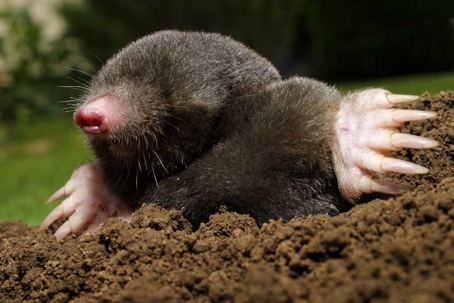
What Do Moles Look Like?
Knowing what moles look like is critical for accurately identifying the animal causing damage. Moles are often confused with other small mammals like voles, shrews, or gophers. Proper identification ensures that control methods are species-specific and effective, rather than wasting time or resources on the wrong approach.
Damage Assessment: Recognizing moles allows you to link their presence to the type of damage observed. Moles primarily create raised tunnels and surface mounds while searching for insects and grubs. Other animals may cause similar-looking damage but with different patterns or feeding habits, so distinguishing moles helps in assessing the extent and nature of the problem.
Behavioral Understanding: Visual recognition helps in understanding mole behavior. Knowing that moles have cylindrical bodies, velvety fur, powerful forelimbs with large digging claws, and small eyes suited for a subterranean life informs how and where they tunnel. This knowledge guides strategic placement of traps or deterrents.
Safety and Legal Compliance: Correctly identifying moles avoids misidentifying non-target wildlife, some of which may be protected by law. Using control methods on the wrong species could result in legal issues or ecological harm.
Recognizing moles also allows for early detection and monitoring. Knowing their appearance and the signs they leave above ground helps in implementing preventative measures before infestations become severe.
Learn more: Moles vs Voles
What Size Are Moles?
Most common moles, such as the Eastern mole (Scalopus aquaticus) in North America, typically have a body length of 4 to 7 inches (10–18 cm), not including the tail. The tail usually adds an additional 1 to 2 inches (2.5–5 cm), depending on the species. Adult moles generally weigh between 2 to 5 ounces (60–140 grams), although some larger species can weigh slightly more.
How Big Are Moles?
While most common moles are small, some species grow significantly larger. The Russian mole (Talpa romana) and Eastern mole (Scalopus aquaticus) are typical examples in North America and Europe, but the largest moles are usually found in Asia.
Body Length: Large mole species can reach up to 8–10 inches (20–25 cm) in body length.
Tail Length: Their tails generally remain short, around 1–2 inches (2.5–5 cm), even in the largest species.
Weight: Large moles can weigh up to 6–8 ounces (170–225 grams), although most remain smaller.
Comparison to Common Species: For perspective, common moles like the Eastern mole usually max out at 7 inches and 5 ounces, so the largest species are roughly 20–30% longer and heavier.
Larger moles can create more extensive tunnel networks and push up more soil, meaning infestations by bigger species may require more robust trapping or exclusion methods.
How Small Are Moles?
Some mole species are notably tiny compared to the common Eastern or European mole. The star-nosed mole (Condylura cristata) and certain shrew-mole species (genus Uropsilus) are among the smallest.
Body Length: The smallest moles can have a body length of around 3–4 inches (7–10 cm), not including the tail.
Tail Length: Their tails are usually very short, typically 0.5–1 inch (1.3–2.5 cm).
Weight: These small species often weigh as little as 1.5–2 ounces (40–60 grams), making them light enough to tunnel through soil with minimal surface disruption compared to larger moles.
Proportion and Adaptation: Despite their small size, they retain the characteristic mole adaptations—powerful digging forelimbs, velvety fur, and reduced eyes. Their compact size allows them to navigate very narrow tunnels efficiently.
Smaller moles can be harder to detect because their mounds and surface activity are less pronounced. This makes early identification and monitoring more important in pest control efforts.
What Color Are Moles?
Most moles have fur that is dark gray to brown, which helps them blend into soil and reduces visibility to predators. Their velvety coat is adapted for moving forward and backward in tunnels without friction.
Underside Color: The belly is often a slightly lighter shade, ranging from medium gray to light brown or buff, but not dramatically different from the back.
Rare Variations: Occasionally, moles can appear reddish-brown, especially in certain regional populations, but this is uncommon. Albino or very light-colored moles are extremely rare in the wild.
Functional Adaptation: The dark fur helps moles avoid predation while moving near the surface, and the dense, short, soft coat reduces soil friction while digging.
Recognizing the typical coloration aids in distinguishing moles from similar pests like shrews, voles, or young gophers, which may have lighter or more varied fur.
Are Moles Gray?
Most moles are naturally gray as part of their normal fur coloration. For example, the Eastern mole (Scalopus aquaticus) and the star-nosed mole (Condylura cristata) typically have medium to dark gray fur throughout their lives.
Habitat Influence: Moles are gray year-round because the color provides camouflage in soil and underground tunnels, regardless of the season. Unlike some animals, their coat does not change color seasonally.
Age Factor: Juvenile moles are often slightly lighter gray than adults, but they darken as their fur matures.
Environmental Conditions: Soil staining can sometimes make moles appear darker or slightly brownish when they emerge at the surface, but the underlying fur is gray.
Gray is the most common color across mole species, distinguishing them from rarer brown, reddish, or albino individuals.
Are Moles Brown?
Some mole species naturally have brown fur rather than gray.
Environmental or Soil Staining: Moles may appear brown when their fur is coated with reddish or brown soil, especially after excavating tunnels in clay or loamy soils. This does not indicate an actual change in fur color.
Juvenile Fur: Some young moles may have slightly lighter, brown-tinged fur before their adult coat fully develops, though they often darken with age.
Regional Variations: Populations in different regions may show subtle brown tones due to genetic variation, but gray remains dominant in most North American species.
Rare Color Mutations: Brownish individuals can occasionally appear as natural color variations or due to environmental factors like mineral-rich soil, but these are not typical for the majority of moles.
A mole that appears brown should still be distinguished from voles or shrews, which are often brown and may share similar size, but have different body shapes, fur textures, and digging behaviors.
What Shape Are Moles?
Moles have a cylindrical, streamlined body designed for efficient movement underground. Their shape minimizes resistance while tunneling through soil.
Head Shape: The head is elongated and pointed, with a slightly conical snout that houses sensitive touch organs. In some species, like the star-nosed mole, the nose has a distinctive star-shaped appendage used for sensing prey.
Limbs and Claws: Forelimbs are broad, spade-like, and turned outward, specifically adapted for digging. Hind limbs are smaller and more tapered, aiding in backward movement through tunnels.
Tail Shape: The tail is usually short and cylindrical, sometimes slightly tapering, and covered in fine hairs.
Eyes and Ears: Eyes are tiny and often not visible externally, reflecting their subterranean lifestyle. External ears are either absent or very small, blending into the body shape.
Every aspect of the mole’s shape—from the compact torso to the powerful forelimbs—is optimized for a burrowing lifestyle, allowing it to push soil aside, navigate narrow tunnels, and hunt for invertebrates efficiently.
Do Moles Have Eyes?
Moles do have eyes, but they are very small, often less than a few millimeters in diameter, and sometimes almost hidden by fur. Their eyes are adapted for a subterranean lifestyle, so they provide limited vision—mostly for detecting light and dark rather than forming detailed images. Because moles spend nearly all their lives underground, relying on sight is not essential; instead, they depend heavily on touch and smell to navigate and find food. In some species, such as the star-nosed mole, the eyes are tiny but functional, while in other species, they are so reduced that they may appear vestigial. The reduced size and minimal exposure of the eyes also help protect them from dirt and debris while digging, making their small eyes a functional adaptation to a life spent almost entirely beneath the soil surface.
Are Moles Blind?
Moles are not completely blind, but they have extremely limited vision. Their eyes are very small and often covered by fur, which restricts their ability to see detailed images. They can generally detect light and dark, helping them sense when they are near the surface or in open areas, but they cannot rely on sight for hunting or navigation. Instead, moles depend heavily on their highly sensitive touch organs, whiskers, and snouts to locate prey and move through their tunnels. In essence, moles are functionally nearly blind, but their other senses are so well-developed that they can thrive underground without strong visual abilities.
Do Moles Have Tails?
Yes, moles do have tails, though they are typically short and inconspicuous. The tail is usually cylindrical, tapering slightly, and covered in fine, short hairs. It serves a few functional purposes: providing balance and sensory feedbackwhile the mole moves through narrow tunnels, helping with steering and backward movement, and in some species, acting as a minor tactile organ to detect contact with tunnel walls. The tail is not used for gripping or digging, so it is much less prominent than the mole’s powerful forelimbs. While small and often overlooked, the tail is a subtle but useful adaptation to the mole’s subterranean lifestyle.
Do Moles Have Whiskers?
Yes, moles have whiskers, which are an important part of their sensory system. These whiskers, located around the snout and sometimes along the body, are highly sensitive tactile hairs that help moles navigate their underground environment. Since moles have very limited vision, they rely on these whiskers to detect obstacles, sense vibrations in the soil, and locate prey such as insects and earthworms. The whiskers allow them to move efficiently through narrow tunnels and respond quickly to changes in their surroundings. In many ways, the whiskers serve as an extension of the mole’s sense of touch, compensating for their near-blindness and enabling them to thrive in a subterranean lifestyle.
Do Moles Have Claws?
Yes, moles have claws, and they are one of their most distinctive and important physical adaptations. Their forelimbs are equipped with large, broad, spade-like claws that are turned outward, allowing them to efficiently dig through soil and create extensive tunnel systems. These claws are extremely strong relative to the mole’s size and are used to excavate dirt, capture prey, and maneuver underground. The hind claws are smaller and less specialized but help with stability and backward movement in tunnels. The combination of powerful claws and muscular forelimbs makes moles highly effective burrowers, allowing them to move soil rapidly and maintain intricate underground networks.
Do Moles Have Ears?
Moles do have ears, but they are very small and often not visible externally, blending into the fur on the sides of the head. Unlike many other mammals, moles do not have prominent external ear flaps; instead, their ear openings are tiny and sometimes covered by skin or fur. This adaptation helps prevent soil from entering the ears while digging. Despite their reduced external appearance, moles have a well-developed sense of hearing and can detect vibrations and sounds in the soil, which is important for locating prey and sensing predators. Essentially, their ears are functional but minimized in size and exposure to suit a subterranean lifestyle.
Are Moles Deaf?
Moles are not deaf, but their hearing is adapted to an underground lifestyle rather than to detecting airborne sounds like many surface-dwelling mammals. Their small, often hidden ears are designed to pick up vibrations and low-frequency sounds transmitted through the soil, which helps them locate prey such as insects and earthworms, as well as detect potential predators or other moles. While they cannot hear in the same way humans or many other mammals do, their sense of hearing—combined with their sensitive whiskers and snout—is highly effective for navigating and surviving underground. So, moles are far from deaf; they simply rely on a specialized form of hearing suited to tunneling and soil-based communication.