
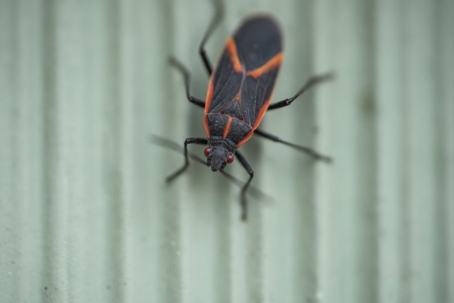
What Do Boxelder Bugs Eat?
Understanding what boxelder bugs (Boisea trivittata) feed on allows pest control professionals to implement targeted strategies. Since these bugs primarily feed on seeds, leaves, and sap of certain trees, identifying these food sources helps predict where infestations are likely to occur and which areas require monitoring or treatment:
Prevention of Structural Invasion: Boxelder bugs are known for congregating on homes in the fall, not because they feed on buildings but because they seek warmth and shelter. Knowing their food preferences can help distinguish whether an infestation is related to landscaping choices or simply seasonal behavior, enabling preventative measures like tree maintenance or removing seed-bearing debris.
Minimizing Plant Damage: While they are mostly nuisance pests, boxelder bugs can cause aesthetic damage to plants, such as stippling on leaves or minor fruit blemishes. Understanding their dietary habits allows for proactive steps to protect ornamental trees and shrubs or fruit-bearing plants, preserving both plant health and landscape appearance.
Strategic Chemical or Biological Control: If chemical or biological control measures are required, knowing their preferred food sources enables precise application. Treatments can be concentrated on host trees rather than widespread, indiscriminate spraying, increasing effectiveness while minimizing unnecessary environmental impact.
Feeding habits are closely linked to reproduction. Boxelder bugs lay eggs on the same host trees they feed on. By identifying and managing these food sources, it is possible to interrupt their breeding cycle, reducing populations in the long term.
What Boxelder Bugs Eat
Boxelder bugs feed mainly on the seeds of boxelder trees, which are their preferred host. They pierce the seeds with their mouthparts to suck out the sap and nutrients.
Other Maples and Ash Trees: Beyond boxelder trees, they also feed on the leaves, flowers, and seeds of certain maple species (like silver maple) and ash trees, though they generally prefer boxelder seeds when available.
Occasional Fruit and Plants: They may occasionally feed on fruit, especially fallen or damaged fruit, including apples, peaches, or berries. However, they rarely cause serious damage to fruit crops.
Plant Sap: Boxelder bugs are sap-feeders, meaning they extract plant fluids using their piercing-sucking mouthparts. This is why they are most commonly found on leaves, flowers, and developing seeds where sap is abundant.
Despite being a nuisance indoors, they do not eat household food, wood, or structural materials. Their “damage” inside homes is primarily cosmetic, such as leaving stains if crushed.
Do Boxelder Bugs Eat Plants?
Boxelder bugs (Boisea trivittata) are most strongly associated with certain trees, especially those in the Acer (maple) family, and their feeding habits tend to be selective rather than indiscriminate. The plants they are most likely to feed on include:
Non-woody plants – Rarely, boxelder bugs may feed on seeds or sap from herbaceous plants, but this is typically opportunistic rather than a primary food source.
- Feeding Behavior: They use piercing-sucking mouthparts to extract sap, primarily from young leaves, stems, and seeds. Damage is usually minor and cosmetic, such as yellowing or browning of leaves, or deformation of seeds, and they are generally not considered significant agricultural pests.
Boxelder bugs are more of a nuisance than a destructive pest. Their presence is most problematic when they aggregate in large numbers on homes during fall, seeking overwintering sites, rather than from the damage they do to plants.
Do Boxelder Bugs Eat Boxelder Trees?
Yes, boxelder bugs do feed on boxelder trees (Acer negundo), but it’s important to understand exactly what they eat and the type of damage they cause.
Feeding Targets: Boxelder bugs primarily feed on the seeds, leaves, and young stems of the boxelder tree. They use their piercing-sucking mouthparts to extract sap.
Preference for Seeds: They have a strong preference for the seeds (samaras), especially in late spring and early summer, when seeds are forming.
Leaves and Stems: They also feed on tender leaves and stems, which can cause minor yellowing or browning, but this rarely affects overall tree health.
Damage Level: The feeding is mostly cosmetic, meaning it may make leaves look spotted or seeds appear shriveled, but it doesn’t typically harm the tree structurally or kill it. Large populations can create noticeable messes around the tree when they gather in fall to overwinter.
Boxelder bugs do eat parts of boxelder trees, but they are not destructive pests. The main issue is their nuisance behavior, especially when they move onto buildings in the fall.
Do Boxelder Bugs Eat Maple Trees?
Yes, boxelder bugs can feed on certain maple trees, but the extent and impact vary:
Preferred Maples: Boxelder bugs most commonly feed on boxelder trees, which are technically a type of maple (Acer negundo). They also feed on other maples in the same genus, particularly Silver maple (Acer saccharinum), Sugar maple (Acer saccharum), and Red maple (Acer rubrum).
Feeding Behavior: They primarily feed on seeds, young leaves, and tender stems. Using their piercing-sucking mouthparts, they extract sap, which may cause minor leaf discoloration or shriveling of seeds.
Impact: While they feed on these maples, damage is mostly cosmetic. Large populations may create noticeable spotting or leaf curling, but they rarely compromise tree health.
Less Common Maples: Boxelder bugs are less likely to feed on mature, hard-leafed maples outside of the species mentioned above. Their feeding preference is strongly tied to the seed and sap composition of certain maples.
While boxelder bugs can feed on maples, their activity is usually limited to species closely related to boxelder, and the trees generally tolerate the feeding without serious harm.
Do Boxelder Bugs Eat Ash Trees?
Yes, boxelder bugs can feed on ash trees, but it’s not their primary preference:
Diet Flexibility: While boxelder trees are their preferred host, boxelder bugs will feed on other trees in the same family, including ash and some maples. They target seeds, leaves, and sometimes flowers, extracting sap through their piercing-sucking mouthparts.
Limited Damage: Feeding on ash trees is usually minor. They may cause some leaf stippling or minor cosmetic damage, but they rarely harm the tree’s overall health.
Reproductive Sites: Boxelder bugs often lay eggs on the trees they feed on. Ash trees can serve as secondary hosts, supporting small populations, especially if boxelder trees are scarce nearby.
Knowing that ash trees can host boxelder bugs helps in monitoring and controlling populations near homes, but treatment is often not necessary unless infestations are large or near entry points. Ash trees are a secondary food source, not their primary target, and infestations on ash are typically more of a nuisance than a serious threat.
Do Boxelder Bugs Eat Fruit Trees?
Yes, boxelder bugs can feed on fruit trees, but their impact is generally minor and mostly cosmetic:
Feeding Behavior: Boxelder bugs are sap-feeders that use piercing-sucking mouthparts to extract plant fluids. On fruit trees, they tend to target seeds, young leaves, and occasionally the fruit itself, especially if the fruit is soft, damaged, or overripe.
Commonly Affected Fruit Trees: Apples, peaches, and sometimes pears can attract boxelder bugs, particularly if there are nearby boxelder or maple trees. However, the feeding is usually superficial and does not compromise tree health or fruit production significantly.
Type of Damage: The damage is largely cosmetic, such as small puncture marks on fruit or slight stippling on leaves. Boxelder bugs do not burrow into fruit or destroy it like some other pests do.
Nuisance Factor: While fruit damage is minimal, boxelder bugs can be a nuisance when large numbers migrate onto trees or into nearby homes for overwintering. Their presence can worry gardeners or homeowners, even if actual harm to the fruit is minor.
Management Considerations: Preventing or reducing populations often involves managing nearby boxelder trees, removing seed pods, or using physical removal methods. Chemical treatments on fruit trees are rarely necessary unless populations are unusually large.
Boxelder bugs may feed on fruit trees opportunistically, mostly causing superficial cosmetic damage rather than serious harm.
Do Boxelder Bugs Eat Wood?
Boxelder bugs do not eat wood. They are herbivorous insects that primarily feed on plant sap, particularly from boxelder (Acer negundo), maple, and ash trees. They have specialized mouthparts for piercing plant tissues and extracting sap, but they are not equipped to consume or digest wood. Therefore, they do not cause any damage to wood or wooden structures.
Boxelder bugs might become a nuisance when they gather in large numbers on or around buildings, including wooden structures. They enter a state of dormancy during the winter months and seek shelter, often congregating in protected areas like wall voids, attics, and other spaces within buildings. While they may stain surfaces with their excrement and emit an unpleasant odor when crushed, they do not eat, bore into, or damage wood in any way.
Will Boxelder Bugs Eat My Garden?
Boxelder bugs are primarily tree feeders, so in a flower garden they are unlikely to cause significant damage. They may occasionally feed on the sap of flowers with soft stems, particularly if the garden is near boxelder, maple, or ash trees. Commonly affected garden flowers could include tender annuals, but feeding is usually minor and cosmetic.
Vegetables (Rare and Opportunistic): Boxelder bugs are not true vegetable pests. They might probe soft fruits or vegetables, such as tomatoes, beans, or peppers, if seeds or damaged tissue are exposed, but serious feeding is uncommon. They do not consume roots, stems, or fully healthy plant tissue.
Fruit-Bearing Plants: If the garden has fruit trees or plants with soft fruits—like squash, cucumbers, or berries—boxelder bugs may occasionally feed on fallen or overripe fruits. Their feeding can leave small puncture marks or superficial blemishes but rarely affects the harvest significantly.
Attraction to Nearby Trees: The presence of boxelder, maple, or ash trees nearby is a stronger predictor of boxelder bug activity than the garden plants themselves. They may wander into gardens while moving from trees to overwintering sites but will not generally establish populations there.
In most flower or vegetable gardens, boxelder bugs are a nuisance rather than a major threat. Monitoring and physical removal (like sweeping or using a vacuum) are usually sufficient if they appear, and preventing congregations by managing nearby host trees is more effective than targeting the garden plants themselves.
What Do Boxelder Bugs Eat In The House?
Boxelder bugs do not eat anything inside houses. When they enter buildings, it is not because they are searching for food. Instead, they seek shelter to escape the harsh winter conditions. They are attracted to the warmth and light that buildings provide, which can make them a nuisance when they congregate indoors.
Boxelder bugs are primarily herbivores, feeding on the sap of certain trees, as mentioned earlier. They do not feed on human food, stored grains, or household materials. Their sole purpose for entering a house is to find a warm and sheltered place to spend the winter in a state of dormancy. They are not destructive pests when it comes to food or property damage.
While they don't eat anything in the house, boxelder bugs can be a temporary annoyance when they gather in large numbers on windowsills, walls, and other indoor surfaces. They may be best removed using a vacuum cleaner or by gently collecting and releasing them outdoors. It's essential to seal any entry points they might use to prevent their entry in the first place.
What Do Boxelder Bugs Eat In The Winter?
During the winter, boxelder bugs do not actively feed. Instead, they enter a state of dormancy or hibernation, known as diapause. Their metabolic activity significantly decreases, and they primarily rely on the energy reserves they have built up during the warmer months. This energy storage typically comes from the sap they consumed from their host plants, such as boxelder, maple, or ash trees.
Boxelder bugs seek sheltered locations to spend the winter, often aggregating in large numbers on the south-facing sides of buildings, under the bark of trees, or in other protected crevices and voids. They enter a state of torpor, where their metabolic rate drops, and they become less active, allowing them to conserve energy.
During this period of inactivity, boxelder bugs do not eat or forage for food. They remain in a relatively dormant state until the temperatures rise in the spring, prompting them to become more active and seek out their host plants for feeding and reproduction. Therefore, their winter survival is reliant on the energy reserves they stored during the warmer months.
Do Boxelder Bugs Eat Other Bugs?
Boxelder bugs are not predatory insects and do not actively hunt or eat other bugs. They are herbivorous insects that primarily feed on the sap of certain trees, such as boxelder, maple, and ash trees. Their diet consists of plant juices, and they use their specialized mouthparts to pierce plant tissues and extract sap.
Boxelder bugs are not known to be natural predators of other insects, and they do not pose a threat to most other bugs. Their feeding habits are limited to plant material, and they are not involved in controlling or preying on other insect populations. Therefore, they are not considered beneficial for pest control in gardens or other environments.
Last Updated: 12/19/2025