
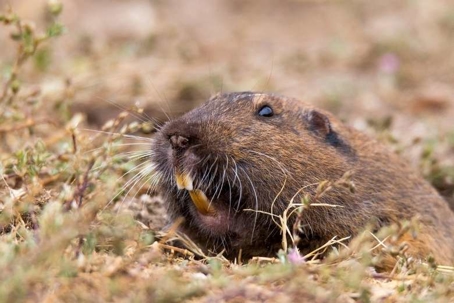
What Do Gophers Look Like?
Gophers are notorious for burrowing and feeding on roots, tubers, and crops. Being able to accurately identify a gopher allows farmers, gardeners, and landscapers to implement targeted pest control measures rather than misidentifying them and potentially harming non-target wildlife.
Property and Infrastructure Protection: Gopher burrows can damage lawns, golf courses, irrigation systems, and building foundations. Recognizing their presence early through visual signs or sightings helps prevent costly structural damage.
Distinguishing from Other Wildlife: Several animals, such as moles, voles, and ground squirrels, create similar burrow patterns but have different behaviors, diets, and control methods. Correct identification ensures the right approach is used, whether for management or coexistence.
Ecological Monitoring: Gophers play a role in soil aeration, nutrient cycling, and creating habitats for other species. Knowing what they look like helps ecologists monitor population health and ecosystem impacts.
Safety and Health: While gophers are generally not aggressive, their burrows can create tripping hazards. Additionally, distinguishing them from other, potentially disease-carrying rodents is useful in areas where zoonotic risks exist.
Being able to recognize a gopher accurately is critical for informed management, safety, ecological balance, and scientific understanding.
What Size Are Gophers?
The size of gophers can vary depending on the species and their age, but in general, gophers are small rodents with the following approximate measurements:
- Length: Gophers typically measure around 6 to 8 inches (15 to 20 centimeters) in body length. This measurement does not include their tail.
- Tail Length: The tail of a gopher can add 6 to 8 inches (15 to 20 centimeters) to their overall length.
- Weight: Gophers are relatively lightweight animals. Depending on the species, their weight can range from 4 to 16 ounces (113 to 453 grams). Young gophers are usually smaller and lighter than adults.
There are several species of gophers, and their size can vary slightly based on the specific species and geographic location. These measurements provide a general idea of the size of gophers, but individual gophers may fall within a range of sizes. Gophers have stout bodies and are adapted for a burrowing lifestyle, with strong forelimbs and a compact build that helps them navigate through tunnels underground.
How Big Can Gophers Get?
The largest gophers, particularly among the pocket gophers in North America, can reach:
Body length (excluding tail): up to about 14 inches (36 cm)
Tail length: up to 5 inches (13 cm)
Weight: up to around 14 ounces (400 grams)
Some of the smaller species, like the western pocket gopher, are much smaller—closer to 5–7 inches in body length and 4 ounces in weight.
So, while most gophers are relatively small rodents, the largest species are roughly the size of a small domestic cat’s head-to-body length and noticeably stocky because of their digging adaptations.
How Small Can Gophers Be?
The smallest gophers, mainly among the western and plains pocket gophers, can be quite tiny:
Body length (head to base of tail): around 5 inches (13 cm)
Tail length: roughly 1–2 inches (2.5–5 cm)
Weight: as little as 4 ounces (110 grams)
These smaller species are compact and stocky, with short limbs and strong claws for digging, so even though they’re small, they look sturdy. For context, a very small gopher could easily fit in the palm of an adult hand.
What Color Are Gophers?
Gophers can exhibit a range of colors, but their fur coloration typically depends on the species, habitat, and geographic region in which they are found. Here are some common colors and patterns of gophers:
- Brown: Many gopher species have brown fur, which can vary from light tan to dark brown. This brown coloration helps them blend in with the soil and vegetation in their burrowing habitats.
- Gray: Some gopher species may have gray fur, which can also vary in shade from light gray to darker hues. Gray-colored gophers are often found in regions with lighter soils.
- Mixed Colors: Gophers may have fur that includes a mix of colors, such as a combination of brown and gray, which can provide camouflage in diverse habitats.
- Darker Markings: Some gophers have darker markings or stripes on their bodies, particularly on their back and sides. These markings can help them remain inconspicuous in their underground burrows.
- Pale or White Areas: In some gopher species, you may find pale or white patches on their fur, especially on their underbellies or around their faces.
Gopher fur coloration can vary not only by species but also within populations. This variation helps gophers adapt to the specific conditions and environments of their habitats. Additionally, young gophers may have slightly different fur colors than adults, with fur often becoming darker as they mature.
What Shape Are Gophers?
Gophers have a distinctive body shape that reflects their burrowing lifestyle. Key features include:
Cylindrical, Stocky Body – Their bodies are compact and barrel-shaped, which allows them to move easily through narrow tunnels. They appear stout rather than elongated.
Short, Powerful Limbs – The forelimbs are especially muscular with large claws for digging. The hind limbs are shorter and more rounded.
Rounded Head with a Blunt Nose – The head is wedge-shaped and slightly flattened, with prominent cheek pouches (for carrying food), giving it a rounded, compact appearance.
Short, Fur-Covered Tail – The tail is relatively short and thick, tapering slightly but covered in fine hair.
Overall Streamlined for Tunneling – From above, gophers appear oval or torpedo-like, minimizing resistance when moving through soil.
Gophers are cylindrical, stocky, and compact, with rounded heads and short tails, perfectly shaped for life underground.
What Gophers Look Like
In addition to their size, color, and shape, gophers possess several physical characteristics that are notable for their adaptations to their burrowing lifestyle and survival in underground environments. Here are some of these features:
- Strong Claws: Gophers have powerful, sharp claws on their front feet. These claws are perfectly suited for digging and excavating tunnels through soil. Their strong forelimbs and claws allow them to efficiently create complex underground burrow systems.
- Cheek Pouches: Gophers have specialized cheek pouches on the sides of their mouths. These expandable pouches allow them to carry food back to their burrows for storage. Gophers are herbivores and primarily feed on plant material, so these pouches are essential for transporting vegetation.
- Teeth: Gophers have large, chisel-like incisors that continuously grow throughout their lives. They use these teeth for gnawing on roots, tubers, and other plant matter, as well as for excavating tunnels and maintaining their burrows.
- Sensory Adaptations: Gophers have small eyes and ears relative to their body size, as they spend the majority of their lives underground. Their eyes are adapted for low-light conditions, while their acute sense of touch and smell helps them navigate in dark tunnels and detect predators or intruders.
- Tail: Gophers have tails that are relatively hairless compared to the rest of their bodies. These tails provide balance and stability as they move through their intricate tunnel systems.
- Fur Adaptations: Their fur is soft and dense, which helps insulate them in the underground environment. It protects from temperature fluctuations and maintains their body warmth.
- Glandular Adaptations: Gophers possess scent glands that they use for marking their territory and communicating with other gophers. These glands secrete specific odors that serve as signals to conspecifics.
- Subterranean Adaptations: Gophers are highly adapted to their subterranean lifestyle. They have well-developed musculature for tunnel digging and can close their lips behind their large incisors to prevent soil from entering their mouths while excavating.
These physical characteristics collectively enable gophers to thrive in their underground habitats, where they construct extensive burrows for shelter, store food, and raise their young while remaining relatively safe from predators.
Do Gophers Have Tails?
Yes, gophers do have tails, but they are relatively short compared to their body length. Key points about gopher tails:
Length: Typically 1–5 inches (2.5–13 cm) depending on the species.
Appearance: Covered in fine fur, often tapering slightly, not bushy like a squirrel’s tail.
Function: While not used for balance like tree-dwelling rodents, the tail can help with stability when moving backward in tunnels and may have a minor role in communication or thermoregulation.
So, a gopher’s tail is small, fur-covered, and cylindrical, complementing its compact, burrowing-adapted body.
Do Gophers Have Eyes?
Yes, gophers have eyes, but they are quite small and adapted to their underground lifestyle. Important details:
Size: Tiny compared to the head—often less than 0.25 inches (6 mm) in diameter.
Position: On the sides of the head, giving them limited forward vision but some peripheral awareness.
Function: Their eyes are not suited for acute vision above ground. Gophers rely far more on touch, smell, and whiskers (vibrissae) to navigate and detect food or danger underground.
Appearance: Eyes are usually dark and somewhat hidden in the fur, giving the gopher a “blunt-faced” look.
Gophers have eyes, but they are small, understated, and secondary to their other sensory adaptations.
Gopher Teeth
Gophers have highly specialized teeth adapted for their burrowing and herbivorous lifestyle:
Incisors: Large, chisel-like, and continuously growing (rootless), so they never wear down completely.
Color: Often orange or yellowish due to iron deposits in the enamel, which strengthens them for gnawing.
Position: Prominent and visible even when the mouth is closed; they can gnaw roots and tunnel through soil without opening their mouth wide.Molars and Premolars: Smaller than incisors and located further back in the mouth. Used mainly for grinding plant material, including roots, tubers, and grasses. Molars are flat and ridged to efficiently break down fibrous plant tissue.
Functionality: Incisors are self-sharpening: the enamel on the front wears slower than the softer dentin behind, creating a chisel edge. Gophers can bite through roots and even tough soil, allowing them to tunnel extensively underground.
Gopher teeth are exposed even when digging, so they don’t wear down on soil as much as you might expect. The combination of strong incisors and grinding molars allows gophers to both excavate tunnels and feed efficiently.