
Do Frogs Lay Eggs?
Yes, frogs are egg-laying animals (oviparous). Female frogs lay eggs in water or in moist environments, depending on the species, and the eggs then develop into tadpoles before metamorphosing into adult frogs.
The eggs are typically surrounded by a gelatinous coating for protection and moisture, and they are laid in clusters, masses, or strings. Frogs do not give live birth; reproduction is entirely through external fertilization, where the male usually fertilizes the eggs as the female lays them.
Frog Eggs
Frog eggs, also known as frogspawn, exhibit distinct characteristics that set them apart from other types of eggs. Frog eggs are typically laid in clusters or gelatinous masses, and their appearance can vary depending on the species of frog. Here is a more comprehensive and detailed description of what frog eggs look like:
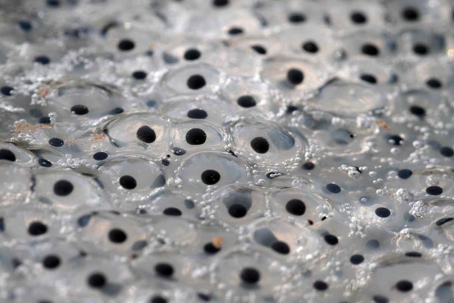
Frog eggs are translucent or semi-translucent, giving them a jelly-like appearance. They are often grouped together in a clear, mucous-like substance. The individual eggs are small, spherical, and range in size from about 1 to 2 millimeters in diameter, depending on the frog species. These eggs are initially white or pale in color but may develop a greenish or brownish hue as they mature.
What Do Frog Eggs Look Like?
Frog eggs exhibit several other physical characteristics beyond their size, color, and general appearance. These characteristics play a vital role in the development and survival of frog embryos. Here are some additional physical characteristics of frog eggs:
Gelatinous Matrix: Frog eggs are typically encased in a gelatinous matrix or jelly-like substance. This matrix provides buoyancy, protection, and support for the eggs. It helps keep the eggs from sinking to the bottom of the water body and provides a barrier against predators and environmental factors.
Adhesion: The gelatinous matrix of frog eggs often allows them to adhere to submerged vegetation, rocks, or other surfaces in the aquatic environment. This adhesion helps anchor the eggs in place and prevents them from being carried away by currents.
Egg Clusters: Frog eggs are typically laid in clusters or groups. The size and arrangement of these clusters can vary among frog species. Some frogs may lay relatively small clusters with just a few eggs, while others may produce larger clusters containing hundreds or even thousands of eggs.
Visible Embryo: As mentioned earlier, frog eggs contain a visible embryo inside each egg. This embryo can often be seen as a dark spot or mass within the translucent egg. The embryo undergoes development and eventually hatches into a tadpole.
Developmental Changes: Frog eggs undergo changes in size, texture, and appearance as they develop. They may swell in size and become less translucent as the embryo inside grows and matures. These changes can provide insights into the developmental stage of the eggs.
Egg Pigmentation Patterns: In some frog species, there may be pigmentation patterns or markings on the egg's surface, although this is not as common as changes in color within the egg. These patterns can be species-specific and may serve various purposes, including camouflage or protection.
Understanding these physical characteristics of frog eggs is essential for researchers and conservationists studying amphibian biology and reproduction, as it provides valuable insights into the adaptations and strategies employed by different frog species for their survival and reproduction.
One of the defining features of frog eggs is the presence of a black or dark-colored embryo visible within each egg. This embryo develops into a tadpole over time. The number of eggs in a cluster can vary significantly, with some species laying just a few dozen eggs while others lay hundreds or even thousands.
Frog eggs are typically found in water bodies like ponds, lakes, marshes, or slow-moving streams. They are often attached to submerged vegetation or other surfaces to protect them from predators and environmental factors. The gel-like matrix that surrounds the eggs provides buoyancy and protection.
As the eggs develop, they undergo a series of transformations, eventually hatching into tadpoles. These tadpoles will later undergo metamorphosis, changing into juvenile frogs and eventually adult frogs. The appearance of frog eggs can be a fascinating and crucial aspect of studying amphibian biology and reproduction, providing valuable insights into the life cycle of these remarkable creatures.
What Shape Are Frog Eggs?
Frog eggs are typically spherical or nearly spherical in shape. They are surrounded by a clear, jelly-like coating that helps protect the developing embryos and keeps them moist. The jelly can make the eggs appear as small, translucent or slightly opaque spheres, often clustered together in a gelatinous mass called a spawn. In some species, the eggs are laid individually or in strings, but the underlying egg shape remains roughly round.
The spherical form is advantageous because it maximizes volume while minimizing surface area, allowing the embryo to stay hydrated and exchange gases efficiently within the jelly.
Are Frog Eggs Round?
Yes, frog eggs are generally round or nearly round. Each egg is a small, spherical cell surrounded by a protective jelly coating. When laid, they often cluster together in jelly-like masses, which can make the individual eggs look slightly irregular, but the fundamental shape of each egg is essentially spherical.
The round shape helps with protection, buoyancy, and efficient nutrient use as the embryo develops.
What Size Are Frog Eggs?
The size of frog eggs can vary depending on the species of frog, but in general, frog eggs are relatively small. Here is a more detailed description of the size of frog eggs:
Frog eggs typically have a diameter that ranges from about 1 to 2 millimeters (mm). The exact size can vary among different frog species. Some frog species may have slightly smaller or larger eggs, but the majority fall within this size range.
To put this size into perspective, frog eggs are smaller than most common bird eggs, such as chicken eggs, which are usually around 3 to 4 centimeters (30 to 40 mm) in length. Frog eggs' relatively small size is adapted to their aquatic environment, where they are laid in clusters and need to remain buoyant and protected within a gelatinous matrix.
Despite their small size, frog eggs are essential for the reproduction and survival of these amphibians, as they develop into tadpoles and, eventually, into adult frogs as part of the frog's life cycle.
How Big Are Frog Eggs?
Frog eggs are generally small, but their size can vary significantly depending on the species. Most frog eggs are about 1 to 3 millimeters in diameter. However, some larger species produce eggs up to 6 to 8 millimeters across.
The jelly coating around each egg can add extra bulk, making the visible egg mass appear bigger. In species that lay eggs in large clusters or strings, the entire mass can be several centimeters wide or long.
Larger eggs often correlate with direct development (where the tadpole stage is skipped) or with species that lay fewer eggs but provide more yolk for each embryo, giving the developing frog a better chance of survival.
How Small Are Frog Eggs?
Frog eggs can be quite tiny, with the smallest species producing eggs around 0.5 millimeters in diameter, roughly the size of a pinhead. Some of the very small tree frogs and tiny tropical species lay eggs this small, often in moist soil, leaf litter, or on vegetation, rather than in open water.
Even though the eggs are minuscule, they still contain enough yolk to sustain the developing embryo until hatching, and the jelly surrounding them, though thinner than in larger eggs, provides protection and moisture.
What Color Are Frog Eggs?
Frog eggs can vary in color, but they are generally translucent or semi-translucent with a pale or white appearance when freshly laid. However, as they develop and mature, the color of frog eggs can change. Here is a more comprehensive description of the coloration of frog eggs:
Are Frog Eggs White?
Frog eggs are generally not pure white. They are usually translucent or clear with a visible yolk that can range from pale yellow to orange or dark brown depending on the species. The jelly surrounding the egg is clear or slightly cloudy, which can sometimes give the egg mass a whitish or milky appearance, especially when light scatters through many eggs clustered together.
So while the eggs might look whitish from a distance, the actual egg contents are not truly white.
Are Frog Eggs Translucent?
Yes, frog eggs are typically translucent. The egg itself, especially the yolk, is visible through the clear, jelly-like coatingthat surrounds it. This translucency allows light to penetrate, which can help with temperature regulation and may aid in oxygen diffusion to the developing embryo.
In some species, the yolk can appear yellow, orange, or dark, making the egg look less clear, but the surrounding jelly is almost always transparent or slightly cloudy. This gives the characteristic appearance of tiny spheres suspended in a gelatinous mass.
Are Frog Eggs Green?
Frog eggs themselves are not naturally green. Most are translucent with a visible yolk that can range from pale yellow to orange or dark brown, depending on the species.
However, some frog eggs may appear greenish because of:
Algae growing on or around the eggs, which is common in aquatic environments. Some species even have a symbiotic relationship with algae that live in the jelly, providing oxygen to the developing embryos.
Pigmentation in the egg yolk or jelly, which can give a greenish tint in certain species, though this is less common.
So while the eggs aren’t inherently green, environmental factors or species-specific traits can make them appear so.
Are Frog Eggs Brown?
Frog eggs themselves are generally not brown, but the yolk inside the egg can sometimes appear dark yellow, orange, or even brownish, depending on the species. The surrounding jelly is usually clear or slightly cloudy, which can make the egg mass look darker overall.
Some species may produce eggs that appear brown when clumped together in thick gelatinous masses or when covered with debris or algae in their aquatic environment. But the brown color usually comes from the yolk’s pigmentation or external factors, not from the egg itself.
The color change in frog eggs is a natural part of their development and is often associated with the development of the embryo within the egg. The specific coloration may also be influenced by factors such as the frog species, environmental conditions, and the availability of nutrients in the water. These color changes can serve as indicators of the health and developmental stage of the frog eggs, making them an essential aspect of studying amphibian reproduction and biology.